
Edible oil processing may seem simple when the oil reaches the kitchen, but producing good-quality oil requires careful control at every stage. From the condition of crude oil to refining, laboratory testing, storage, and packaging, each step can affect the final product.
Thank you for reading this post, don't forget to subscribe!Edible oil processing and quality control go hand in hand. Refining removes unwanted impurities, reduces undesirable odors and colors, and helps the oil meet its intended specifications.
Quality control, meanwhile, determines whether the process is working properly and whether the finished oil meets the requirements for release.
The exact refining method used in edible oil processing depends on the type of oil, its initial quality, the refinery equipment, and the requirements of the finished product. Some oils need additional treatment, such as dewaxing, while others can follow a simpler refining route.
In this guide, we will look at the main stages of edible oil refining, the laboratory tests used to monitor quality, common processing problems, and practical ways to improve quality control in an edible oil plant.
1. What Is Edible Oil Processing?
Edible oil processing converts crude or extracted vegetable oil into a product with the required quality, stability, appearance, and characteristics for food use.
Crude oil naturally contains substances that may need to be reduced or removed before the oil is ready for consumption. These can include free fatty acids, phospholipids, pigments, moisture, suspended impurities, and compounds responsible for undesirable odors.
The main objectives of refining are to:
- Remove unwanted impurities and reduce excessive free fatty acids where required.
- Improve color, odor, and overall product acceptability.
- Support the desired shelf life and storage stability.
- Meet applicable food regulations, customer requirements, and product specifications.
- Control refining losses while preserving desirable oil components.
Not every vegetable oil requires the same treatment. For example, soybean oil often needs effective degumming, while sunflower oil may require dewaxing to maintain clarity during cooler storage.
The Codex Standard for Named Vegetable Oils (CXS 210-1999) provides an international reference for the oils covered by its scope. Actual acceptance criteria should be selected according to the applicable standard, national regulations, customer specifications, and intended use.
Reference: Codex Alimentarius — Standard for Named Vegetable Oils
2. Main Stages of Edible Oil Refining
2.1 Crude Oil Receiving and Quality Assessment
Good refining starts with good information about the incoming oil. In edible oil processing, the quality-control laboratory should evaluate the crude oil before processing begins and determine whether it meets the approved receiving specification.
This initial assessment helps the production team understand the condition of the raw material and identify any treatment challenges before they affect the rest of the process. Effective edible oil processing and quality control therefore begins with reliable raw-material inspection and laboratory testing.
Depending on the oil and the refinery’s control plan, incoming tests may include:
- Free fatty acid (FFA) content or acid value.
- Peroxide value to assess primary oxidation products.
- Moisture and volatile matter.
- Phosphorus content where relevant.
- Color, odor, and visible impurities.
- Fatty acid composition or other identity tests when required.
Sampling is just as important as testing. A result is useful only when the sample adequately represents the delivery or storage tank.
If an incoming result falls outside the approved limits, the material should be evaluated before use. Simply proceeding with the usual refining conditions may lead to unnecessary losses or difficulties later.
For this reason, edible oil processing should follow documented receiving specifications, representative sampling procedures, and clear acceptance or rejection criteria.
2.2 Degumming
Degumming is an important stage in edible oil processing that removes phospholipids and related impurities from crude oil. These substances can interfere with later refining operations if they remain at excessive levels.
In water degumming, water is added under controlled conditions to hydrate removable phospholipids. Other methods, including acid and enzymatic treatments, may be used when a higher level of removal is needed.
The choice of treatment depends on the oil, refining route, equipment, and required phosphorus level.
During degumming, the team should pay attention to:
- Incoming phosphorus content and the required residual level.
- Water or other treatment-agent dosage.
- Mixing and contact conditions.
- Separation efficiency.
- Residual phosphorus in the treated oil.
Phosphorus testing is particularly important when preparing oil for physical refining, which generally requires more effective phospholipid removal than conventional chemical refining.
A useful point to remember is that a visually clear oil is not necessarily adequately degummed. Laboratory results are needed to confirm whether the treatment has achieved its purpose.
Therefore, effective edible oil processing and quality control require routine phosphorus monitoring to verify degumming performance and ensure that the oil meets the requirements of subsequent refining stages.
2.3 Neutralization
In chemical refining, neutralization reduces free fatty acids by reacting them with an In edible oil processing, chemical neutralization reduces free fatty acids (FFA) by reacting them with an alkaline solution, commonly sodium hydroxide. The reaction produces soap, which is then separated from the oil as soapstock.
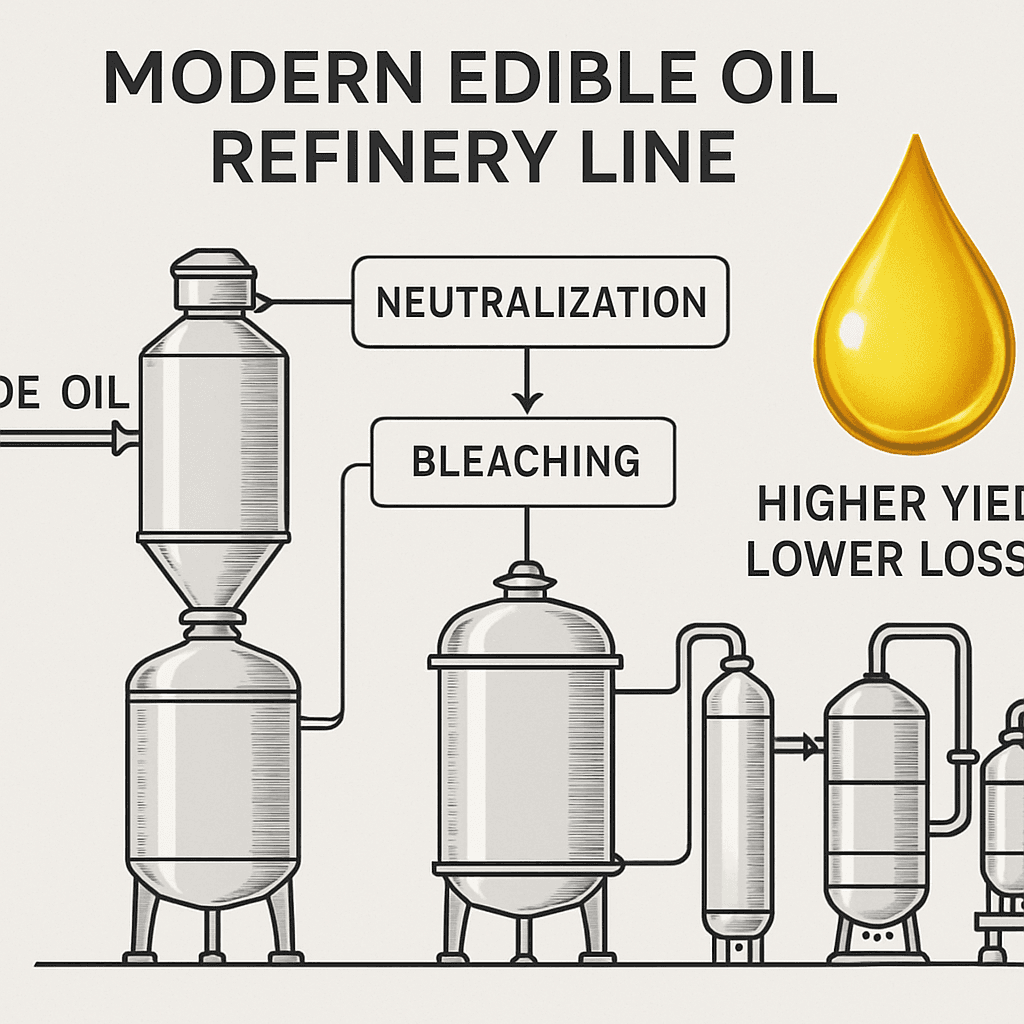
The objective is to reduce acidity without losing excessive neutral oil.
Poor control can create two common problems: excessive residual acidity or unnecessary oil loss. The result depends on factors such as the incoming FFA level, alkali dosage, mixing, separation efficiency, and the amount of oil carried into the soapstock.
Important checks include:
- FFA or acid value before and after treatment.
- Caustic concentration and dosage.
- Soap separation efficiency.
- Residual soap after separation and washing, where applicable.
- Moisture following washing and drying.
Water washing may be used to remove residual soap, followed by drying when required. The washing conditions must be appropriate for the process because poor separation or excessive water carryover can create further difficulties.
Physical refining follows a different route. Instead of relying primarily on alkaline neutralization, it removes free fatty acids mainly through steam distillation under vacuum during deodorization.
Understanding these differences is essential for effective edible oil processing and quality control, particularly when selecting refining conditions and monitoring finished-oil specifications.
Read more: How to Reduce Neutralization and Bleaching Losses in Oil
2.4 Bleaching
Edible Oil Processing: Bleaching is an important step in edible oil processing, used to reduce pigments and selected impurities with the help of adsorbents, commonly bleaching earth. Activated carbon or other specialized adsorbents may also be used for particular applications.
However, bleaching is not simply a matter of making the oil as light as possible. The treatment must achieve the required quality without creating avoidable oil losses or unnecessary processing costs.
Bleaching performance depends on several operating factors:
- Type and dosage of bleaching earth.
- Oil temperature and contact time.
- Mixing and vacuum conditions.
- Moisture content and the condition of the oil.
- Filtration efficiency after treatment.
Overusing bleaching earth can increase the quantity of oil retained in the spent material. On the other hand, insufficient treatment may leave undesirable color or other impurities.
The quality-control laboratory should evaluate relevant parameters such as color, residual soap, and phosphorus where appropriate. The production team should also monitor filtration performance and bleaching-earth consumption.
Comparing color results with adsorbent consumption and oil losses can help identify opportunities to improve efficiency.
2.5 Dewaxing or Winterization
Some vegetable oils contain waxes that can crystallize when stored at lower temperatures. During edible oil processing, these crystals may cause cloudiness or haze, even when the oil appears clear at room temperature.
Dewaxing, or winterization, uses controlled cooling to encourage crystal formation, followed by separating the crystals from the oil.
This treatment is especially relevant when a product must remain clear under defined low-temperature storage conditions.
Quality checks may include:
- Visual appearance after treatment.
- Clarity under specified cooling conditions.
- Storage observations over a defined period.
- Confirmation that the process meets the finished-product specification.
A simple inspection at room temperature may not reveal a clarity problem that develops several hours or days later under cooler conditions. Therefore, edible oil processing and quality control should include suitable low-temperature testing to confirm that the finished oil maintains the required clarity during storage.
2.6 Deodorization
In edible oil processing, deodorization removes volatile compounds responsible for undesirable flavors and odors. It normally uses steam under vacuum at controlled temperatures.
Depending on the refining process, deodorization can also reduce residual free fatty acids and other volatile compounds. However, excessive thermal treatment may affect desirable minor components and contribute to unwanted changes in oil quality.
For this reason, the objective is not to use the highest possible temperature or the longest possible treatment. The goal is to achieve the required product quality under suitable, validated conditions.
The main control points include:
- Vacuum performance.
- Oil temperature and residence time.
- Steam supply and operating conditions.
- Final odor and other sensory characteristics.
- Relevant laboratory results and process records.
Operating conditions vary with oil type, equipment design, and the intended product. A setting that works well for one oil should not automatically be applied to another.
2.7 Final Filtration, Cooling, Storage, and Packaging
Once refining is complete, the oil must be handled carefully to preserve the quality achieved during edible oil processing.
Problems can still develop after processing if the oil is exposed to excessive heat, oxygen, moisture, unsuitable storage conditions, or contamination from equipment and transfer lines.
Before packaging or dispatch, the plant should ensure that:
- The oil has received the required final treatment.
- Tanks, pipelines, and transfer equipment are suitable and clean.
- Storage conditions are appropriate for the product.
- Packaging materials are suitable for food contact.
- Batch identification and traceability records are complete.
Good storage practices are particularly important for oxidation control. Even a well-refined oil can deteriorate if it is exposed to unfavorable conditions during storage and transport.
Therefore, effective edible oil processing and quality control should extend beyond refining to include proper storage, packaging, and product handling.
Reference: Codex Code of Practice for the Storage and Transport of Edible Fats and Oils in Bulk
3. Critical Quality-Control Checks During Refining
3. Critical Quality-Control Checks During Refining
Each refining stage has its own purpose, so the quality checks should reflect the potential problems at that stage. Testing every parameter at every point is not always necessary; what matters is having a clear, technically justified control plan.
| Process stage | Main objective | Useful quality checks |
| Crude oil receiving | Understand incoming oil condition | FFA/acid value, PV, moisture, color, phosphorus where relevant |
| Degumming | Remove phospholipids | Residual phosphorus and separation performance |
| Neutralization | Reduce FFA | FFA/acid value, residual soap, separation efficiency |
| Bleaching | Reduce pigments and selected impurities | Color, residual soap, phosphorus where relevant |
| Dewaxing | Achieve required low-temperature clarity | Appearance and clarity under defined conditions |
| Deodorization | Remove unwanted volatile compounds | Sensory checks, process records, specified laboratory tests |
| Finished-oil storage | Preserve product quality | Release tests, tank inspection, batch traceability |
A good control plan specifies the sampling point, test method, frequency, acceptance criteria, responsible personnel, and action required when a result is outside the approved limits.
4. Essential Laboratory Tests for Edible Oil
4. Essential Laboratory Tests for Edible Oil
Laboratory results help quality personnel assess whether refining is performing as expected. However, no single test provides a complete picture of oil quality. Results must be interpreted in the context of the product, method, and process history.
Common Tests and Their Purpose
| Test | What it tells us | Important consideration |
| Free fatty acids (FFA) | Proportion of free fatty acids, commonly reported as a percentage on a defined basis | The reporting basis must be specified |
| Acid value | Amount of alkali, expressed as mg KOH/g, required to neutralize acids in the oil | It is not numerically identical to FFA percentage |
| Peroxide value (PV) | Information about primary oxidation products | It may decrease as peroxides decompose |
| Anisidine value (AnV) | Information about certain secondary oxidation products, particularly aldehydes | It complements PV but does not measure every oxidation product |
| Iodine value (IV) | A measure related to the degree of unsaturation | It is not a direct test of freshness |
| Phosphorus | Helps assess phosphorus-containing residues, particularly phospholipids | Its importance depends on the refining route |
| Moisture and volatile matter | Measures water and volatile matter under the specified method | The method and sample handling matter |
| Color | Describes the oil’s color characteristics | Instrument and measurement conditions affect comparison |
| Fatty acid profile | Shows the relative fatty acid composition | Useful for composition, identity, and authenticity investigations |
Suitable recognized methods include ISO 660 for acid value and acidity, ISO 3960 for peroxide value, ISO 6885 for anisidine value, ISO 3961 for iodine value, ISO 662 for moisture and volatile matter, and ISO 10540-1 for phosphorus by a colorimetric method. Laboratories should confirm the current applicable editions and follow the complete method requirements.
FFA and Acid Value: Why the Difference Matters
FFA and acid value are related, but they are expressed differently.
- FFA is generally reported as a percentage based on a specified fatty acid equivalent.
- Acid value is reported in milligrams of potassium hydroxide required to neutralize the acids in one gram of oil.
- Converting between them requires a defined fatty acid basis.
- Acid-value measurement determines acidity; it is not inherently specific to free fatty acids alone.
For routine quality control, the laboratory should use the unit and reporting basis specified in the applicable method or product specification.
Understanding Peroxide Value and Anisidine Value
In edible oil processing, peroxide value (PV) is commonly used to assess primary oxidation products. Anisidine value (AnV) provides additional information about certain secondary oxidation products, particularly aldehydes.
Using both tests in edible oil quality control can provide a better indication of oxidation than relying on peroxide value alone.
For example, an oil may show a relatively low peroxide value after prolonged deterioration because some hydroperoxides have already decomposed. If the anisidine value or sensory characteristics are abnormal, the oil may still need further investigation.
These results should therefore be interpreted together with the oil’s storage history, appearance, odor, and other relevant measurements.
Read more: Anisidine Value in Edible Oils
5. How to Improve Quality Control in an Edible Oil Plant
An effective quality-control program should do more than identify failures in the finished product. It should help the production team recognize changes early and make evidence-based decisions.
Establish Clear Specifications
Maintain approved acceptance criteria for crude oil, intermediate materials, and finished products. These criteria should be based on applicable regulations, recognized standards, customer requirements, and validated internal specifications.
The specification should clearly define:
- Required tests and analytical methods.
- Units and reporting basis.
- Acceptance limits.
- Sampling frequency.
- Responsibilities for review and approval.
- Actions required when results are outside specification.
Maintain Reliable Laboratory Results
Even a well-designed edible oil processing control plan can fail if the laboratory results are unreliable. Sampling, sample preparation, instrument performance, calculations, and analyst competency all affect the final result.
Useful laboratory practices for edible oil processing and quality control include:
- Following documented and appropriate test methods.
- Maintaining instruments and monitoring analytical performance.
- Using suitable reference materials and quality-control samples.
- Recording results and calculations accurately.
- Investigating unexpected results before making process changes.
Where more than one analytical method is available, the laboratory should define which method is used for routine control and how discrepancies are evaluated.
Reliable laboratory data are essential for effective edible oil processing, consistent product quality, and informed decisions about process adjustments.
Monitor Trends, Not Just Individual Results
A result may still meet specification while showing a pattern that deserves attention. Trending helps identify such changes before they develop into a larger problem.
In edible oil processing, a gradual increase in residual phosphorus may indicate changes in degumming efficiency. Similarly, repeated increases in residual soap or bleaching-earth consumption may point to a process-control or separation issue that requires investigation and corrective action.
Regular reviews should consider laboratory data alongside production conditions, raw-material quality, maintenance activities, and refining-loss records.
Manage Nonconforming Oil Properly
When a result fails the approved specification during edible oil processing, the affected material should be identified and held while the issue is investigated.
The investigation should consider:
- Whether the correct sample and batch were tested.
- Whether the analytical method and calculations were valid.
- Whether the result can be explained by process conditions.
- Whether additional testing is justified under the laboratory procedure.
- What corrective action or disposition is appropriate.
Retesting should not become a way to ignore a valid failure. Reprocessing, rejection, or release decisions should be authorized and documented according to the plant’s quality system. Effective edible oil processing and quality control require proper nonconformance management, traceability, and documented authorization before affected material is released.
6. Common Edible Oil Processing Problems and Quality Control Troubleshooting
Quality problems are easier to resolve when the investigation focuses on the likely cause rather than immediately changing several process parameters.
High Residual Phosphorus
Possible causes include unsuitable treatment conditions, inadequate contact, poor separation, or variation in the incoming crude oil.
Check the incoming phosphorus level, degumming conditions, separation performance, sample representativeness, and analytical method before deciding on corrective action.
Excessive Residual Soap
Residual soap after neutralization may result from inadequate separation, inappropriate treatment conditions, or ineffective washing where washing is part of the process.
Review the alkali dosage, mixing, separator performance, and washing conditions. Confirm that the analytical result is reliable before making significant operating changes.
Unexpected Refining Losses
High refining losses can have more than one cause. Incoming FFA, oil entrainment in soapstock, oil retained in spent bleaching earth, and separation problems may all contribute.
A useful investigation includes:
- Reviewing the incoming oil quality.
- Checking soapstock and spent bleaching-earth losses.
- Examining separation and filtration performance.
- Verifying production measurements and mass-balance calculations.
- Comparing results across batches and process conditions.
Read more: How to Reduce Refining Losses in Edible Oil
Darkening or Color Reversion
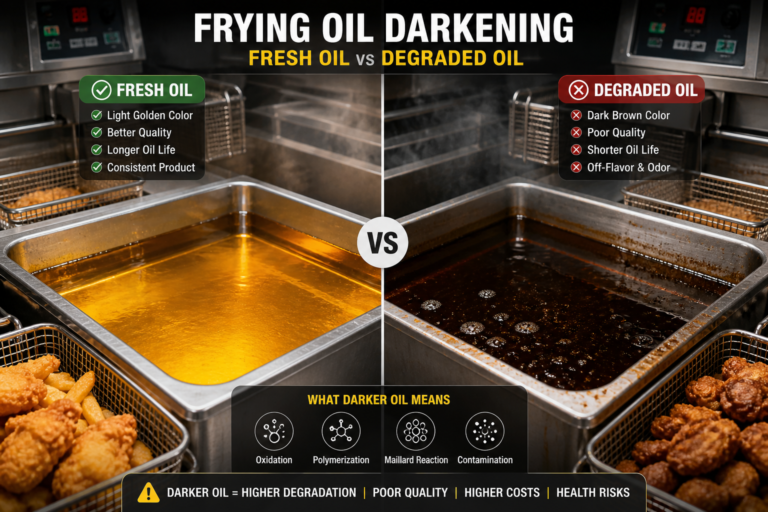
An oil may meet the initial color target but become darker during storage. Possible contributing factors include the original oil condition, refining effectiveness, trace metals, oxidation, and storage conditions.
Review the full process history rather than assuming that the bleaching stage is always responsible.
Further reading: Color Reversion in Edible Oils: Causes and Control
Increasing Oxidation During Storage
If oxidation indicators increase during storage, investigate possible exposure to oxygen, heat, light, unsuitable storage materials, or contamination. In edible oil processing, controlling these factors is essential for maintaining oil stability throughout storage and distribution.
Evaluate peroxide value together with secondary oxidation measurements and sensory observations where appropriate. Review storage temperatures, tank conditions, packaging, and the time elapsed since production.
Remember that no single oxidation test can explain every deterioration pattern. Effective edible oil processing and quality control require a combined assessment of laboratory results, storage conditions, and product characteristics to identify the likely cause and determine appropriate corrective action.
7. Finished Oil Release and Traceability
The final quality decision should be based on documented evidence, not appearance alone. Before release, authorized personnel should verify that the product meets its approved specification and that all necessary records are complete.
A practical release checklist includes:
- Required laboratory tests meet the applicable criteria.
- Appearance and odor meet the product requirements.
- Packaging and closures meet the defined requirements.
- Batch identification and production records are complete.
- Deviations and investigations have been resolved appropriately.
- Release approval has been recorded by authorized personnel.
Additional testing may be required according to the raw material, processing route, market, and applicable regulations. Routine measurements such as FFA, peroxide value, and color cannot demonstrate the absence of every possible contaminant.
Fatty acid profiling by gas chromatography can support compositional assessment and investigations into oil identity or possible adulteration.
Further reading: GC Analysis of Fats for Fatty Acid Composition
Conclusion
Producing consistent edible oil requires attention to every stage of edible oil processing, from receiving crude oil to final packaging. Degumming, neutralization, bleaching, deodorization, and any additional finishing treatments must be controlled according to the oil’s characteristics and the finished-product requirements.
The strongest quality-control programs combine representative sampling, reliable laboratory methods, clear specifications, process trending, and documented release decisions.
Effective edible oil processing and quality control help identify deviations early, minimize processing losses, and maintain consistent product quality.
The practical takeaway is simple: good quality is not achieved through refining alone. Successful edible oil processing depends on understanding the oil, monitoring the process, interpreting laboratory results correctly, and taking timely action when something changes.
Frequently Asked Questions
1. What are the main stages of edible oil refining?
The main stages of edible oil processing may include degumming, neutralization or physical removal of free fatty acids, bleaching, and deodorization. Dewaxing or winterization may also be needed for particular oils.
2. Which laboratory tests are commonly used for refined edible oil?
In edible oil processing and quality control, common tests include FFA or acid value, peroxide value, color, and moisture and volatile matter. Anisidine value, phosphorus, residual soap, fatty acid composition, and other laboratory tests are selected according to the product and process requirements.
3. What is the difference between chemical and physical refining?
Chemical refining removes free fatty acids mainly through alkaline neutralization, which produces soapstock. Physical refining removes them primarily through steam distillation under vacuum. Physical refining generally requires more stringent phospholipid removal during pretreatment.
4. Does a low peroxide value always mean that oil is fresh?
No. Peroxide value measures primary oxidation products that can later decompose. Secondary oxidation measurements, sensory observations, and storage history can provide additional information.
5. Why is phosphorus testing important?
In edible oil processing, phosphorus testing helps assess residual phosphorus-containing compounds, particularly phospholipids. It is especially useful for determining whether the oil is adequately prepared for a physical refining route.
6. Can the same quality limits be used for every vegetable oil?
No. Different oils have different compositions, processing requirements, and intended uses. In edible oil processing, acceptance criteria should follow the relevant standards, regulations, customer requirements, and validated product specifications.

Leave a Comment