
Introduction to Anisidine Value:
Anisidine Value in Edible Oils is a critical quality attribute of edible oils and fats. During storage, processing, and thermal exposure, lipids undergo oxidation, leading to the formation of compounds that adversely affect flavor, safety, and shelf life.
Thank you for reading this post, don't forget to subscribe!While early stages of oxidation generate hydroperoxides, advanced stages produce secondary oxidation products such as aldehydes and ketones.
These secondary compounds are primarily responsible for rancid odors and undesirable sensory characteristics.
The anisidine value (AnV) is a widely accepted analytical parameter used to quantify secondary oxidation products in edible oils.
Unlike peroxide value, which reflects initial oxidation, anisidine value provides insight into deeper oxidative degradation.
Therefore, anisidine value plays a crucial role in oil quality evaluation, particularly for refined and stored oils.
What is Anisidine Value (AnV)?
Anisidine value is defined as a measure of aldehydic secondary oxidation products present in fats and oils.
It is determined by reacting oil samples with p-anisidine reagent and measuring the resulting color intensity spectrophotometrically.
Scientifically, anisidine value reflects the concentration of α, β-unsaturated aldehyde, such as 2-alkenals and 2,4-dienals, formed during the decomposition of lipid hydroperoxides.
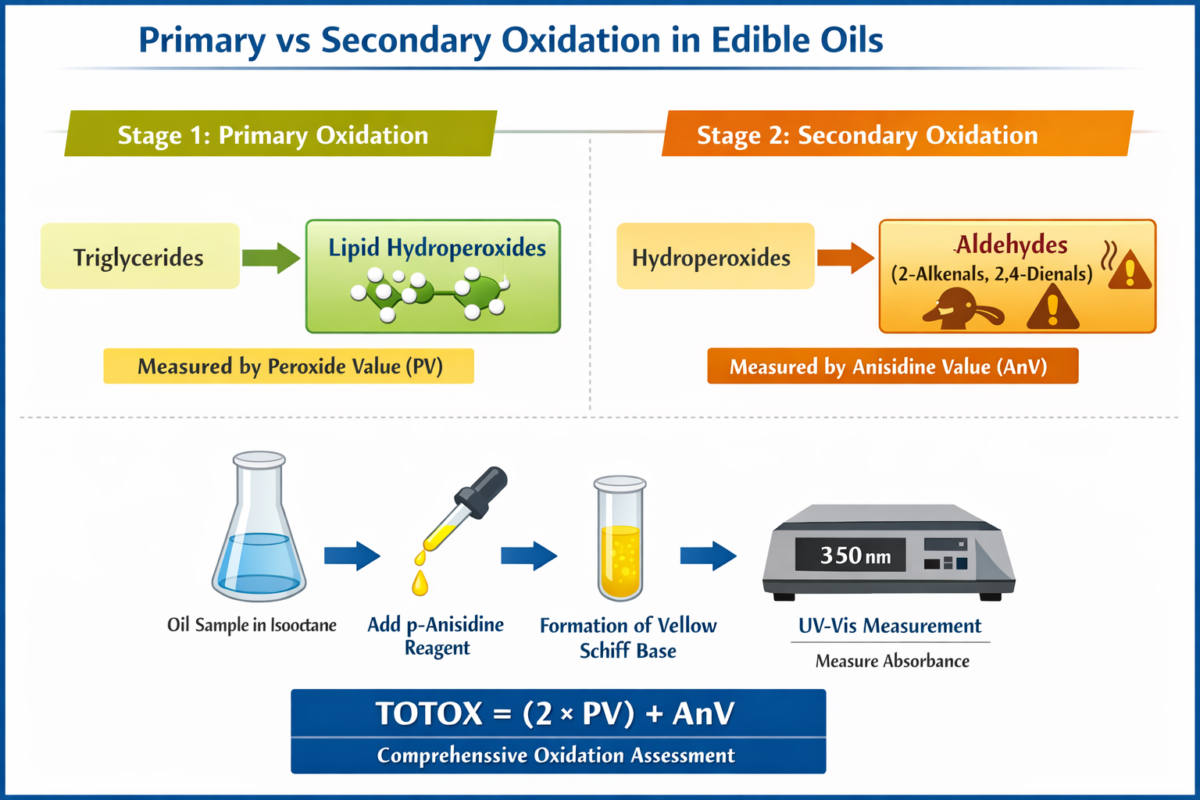
These aldehydes react with p-anisidine to form Schiff bases that absorb light at 350nm. The absorbance magnitude is directly proportional to the level of secondary oxidation.
Importance of Anisidine Value in Edible Oils and Fats:
Anisidine value is a reliable indicator of oxidative deterioration beyond the initial stages. In refined oils, peroxide values are often low due to deodorization, which removes hydroperoxides.
However, aldehyde formed earlier may persist, making anisidine value essential for detecting hidden oxidation damage.
For refined, bleached, and deodorized (RBD) oils, anisidine value is particularly relevant because it reflects oxidation history rather than current peroxide levels.
Elevated anisidine values are strongly associated with off-flavors, reduced shelf life, and poor consumer acceptability.
Consequently, anisidine value is routinely used in quality control programs to ensure product freshness and compliance with customer specifications.
Primary vs Secondary Oxidation in Edible Oils:
Lipid oxidation occurs in two main stages: primary and secondary oxidation. Primary oxidation involves the formation of hydroperoxides, which are measured by peroxide value (PV).
These compounds are unstable and readily decompose into secondary oxidation products.
Secondary oxidation produces aldehydes, ketones, and acids, which directly contribute to rancidity.
Anisidine value specifically measures these aldehyde compounds. Therefore, peroxide value alone is insufficient to assess oil quality, especially in stored or heat-treated oils.
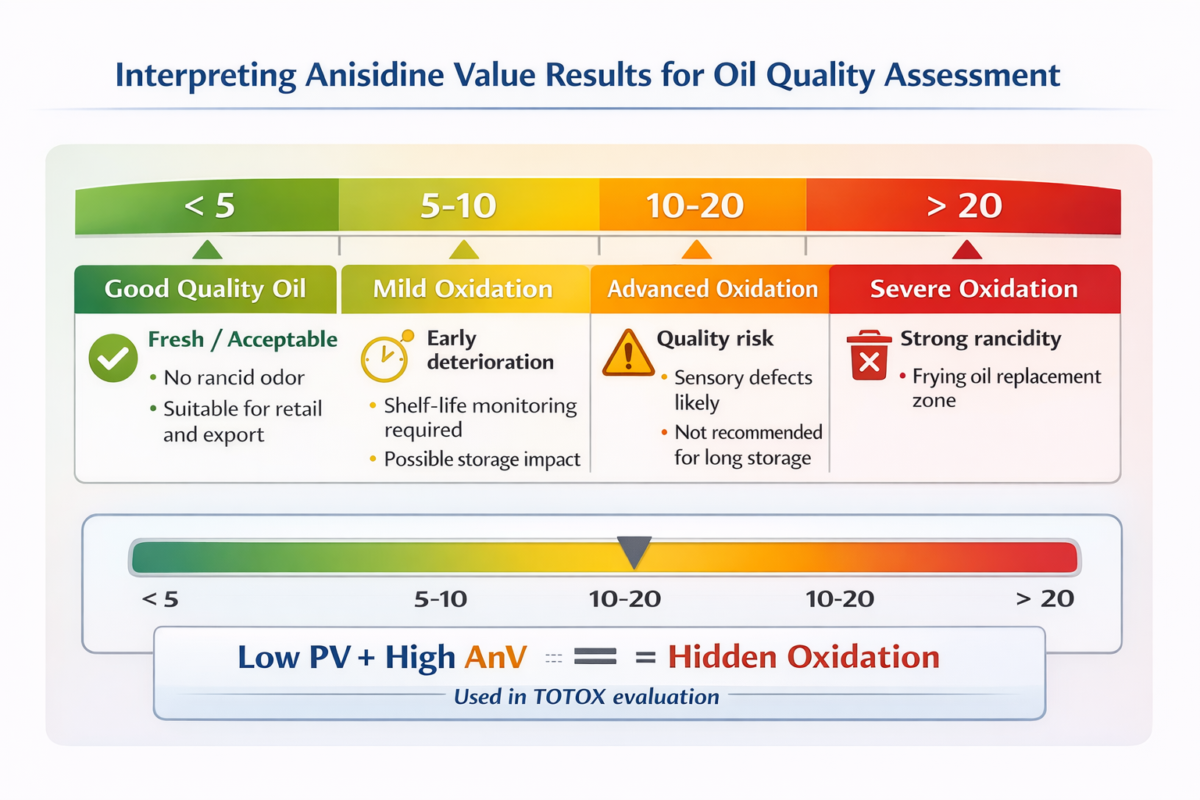
An oil may exhibit a low PV while possessing a high anisidine value, indicating advanced oxidation. For this reason, anisidine value is essential for comprehensive oxidation assessment.
Oils Commonly Evaluated for Anisidine Value in Edible Oils:
Anisidine value is commonly applied to a wide range of edible oils and fats. Vegetable oils such as soybean, sunflower, canola, palm, and corn oil are routinely evaluated during refining and storage.
Oils with higher unsaturation are particularly prone to secondary oxidation.
Hydrogenated and interesterified fats are also monitored due to their processing history and storage sensitivity.
Additionally, anisidine value is widely used to assess used and frying oils, as repeated heating accelerated aldehyde formation.
In such applications, anisidine value serves as a practical indicator of oil degradation and as a basis for determining discard points.
Chemical Principle of the Anisidine Value Test:
The anisidine value test is based on the chemical reaction between aldehydes and p-anisidine (4-methoxyaniline) in an acidic medium.
The amino group of p-anisidine reacts with the carbonyl group of aldehydes to form a Schiff base.
This reaction produces a yellow-colored compound with strong absorbance at 350nm.
The increase in absorbance after reaction is proportional to the concentration of aldehydic secondary oxidation products in the oil.
The test is most sensitive to unsaturated aldehydes, which dominate secondary oxidation in edible oils.
AOCS / ISO Standard Methods for Anisidine Value:
Anisidine value determination is standardized under AOCS Official Method Cd 18-90 and ISO 6885.
These methods specify reagent preparation, sample size, reaction time, and measurement conditions to ensure reproducibility and comparability of results.
The methods are applicable to most refined edible oils but have limitations when applied to highly colored or unrefined oils.
Strict adherence to standardized procedures is essential for obtaining reliable anisidine value results in industrial and laboratory settings.
Reagents and Apparatus Used:
The primary reagent used in anisidine value determination is p-anisidine, typically prepared as a 0.25% solution in glacial acetic acid.
Isooctane is used as a solvent for oil samples because it has low absorbance at 350nm. A UV-Visible spectrophotometer capable of measurement at 350nm is required, along with matched 1 cm quartz or glass cuvettes.
Analytical balances, volumetric flasks, pipettes, and clean glassware are essential to maintain accuracy and precision
Step-by-Step Test Procedure:
In the standard procedure, a known mass of oil is dissolved in isooctane and diluted to a fixed volume. The initial absorbance of this solution is measured at 350nm to account for inherent sample color.
A portion of the solution is then reacted with p-anisidine reagent and allowed to stand for a specified time, usually 10 minutes.
After reaction, absorbance is measured again at 350nm against an appropriate blank. The difference in absorbance is used to calculate the anisidine value.
Calculation of Anisidine Value:
Anisidine value is calculated using the formula specified in AOCS Cd 18-90, which incorporates absorbance readings before and after the reaction, the sample mass, and the dilution factors.
The result is expressed as a dimensionless number representing the extent of secondary oxidation. Accurate weighing, correct dilution, and precise absorbance measurement are critical for reliable calculations.
Interpretation of Anisidine Value Results:
For refined edible oils, anisidine values below 5 are generally considered indicative of good quality. Values between 5 and 10 suggest mild oxidation, while values above 20 indicate significant oxidative deterioration and likely sensory defects.
In stored oils, an increase in anisidine value over time indicates ongoing secondary oxidation and reduced shelf life.
Therefore, trend analysis is often more informative than single-point measurements.
Factors Affecting Anisidine Value in Edible Oils:
Several factors influence anisidine value, including refining conditions, deodorization temperature, and storage environment.
High temperatures, oxygen exposure, light, and metal contaminants accelerate aldehyde formation.
Frying and repeated heating dramatically increase the anisidine value due to continuous oxidation and breakdown of triglycerides.
Conversely, antioxidants and controlled storage conditions help limit secondary oxidation.
Anisidine Value in Frying Oils and Used Oils:
In frying operations, anisidine value is a practical tool for monitoring oil degradation. As frying time increases, aldehydic compounds accumulate, leading to rising anisidine values.
High anisidine values correlate with increased polar compounds and polymerization products. Many food operations establish internal anisidine value limits to determine oil replacement schedules and maintain product quality.
Combined Oxidation Indices (TOTOX Value):
To assess total oxidation, anisidine value is often combined with peroxide value in the TOTOX index, calculated as:
TOTOX = (2 x PV) + AnV
This combined index accounts for both primary and secondary oxidation products. Anisidine value is critical in this calculation because it reflects irreversible oxidative damage not captured by peroxide value alone.
TOTOX is widely used in quality assurance and specification setting.
Limitations of the Anisidine Value in Edible Oils:
Despite its usefulness, the anisidine value test has limitations. It is selective mainly for unsaturated aldehyde and does not quantify all secondary oxidation products.
Highly colored oils may interfere with the absorbance measurement.
Additionally, the test is not suitable for samples with very high peroxide values, as residual hydroperoxides may interfere with the reaction.
Therefore, anisidine value should be interpreted alongside other oxidation parameters.
Troubleshooting and Good Laboratory Practices:
Accurate anisidine value determination requires fresh reagents, peroxide-free solvents, and properly calibrated instruments. Reaction time and temperature must be strictly controlled.
Proper handling of hazardous reagents, use of blanks, and routine instrument verification are essential to ensure data reliability and laboratory safety.
Industrial and Regulatory Significance
Anisidine value is widely used in edible oil refineries, food manufacturing, and regulatory compliance.
It is included in customer specifications, export documentation, and internal quality standards.
For food technologists, the anisidine value provides a scientifically robust measure of oil oxidation history and supports decision-making on shelf life, product acceptance, and process optimization.
Conclusion: Anisidine Value in Edible Oils.
Anisidine value is a critical analytical parameter for assessing secondary oxidation in edible oils and fats. It complements peroxide value by revealing aldehydic degradation products responsible for rancidity and flavor deterioration.
Routine monitoring of anisidine value, particularly in refined and frying oils, enables effective quality control and shelf-life management.
When used alongside other oxidation indices, anisidine value supports the production and distribution of high-quality, stable edible oils.