
Introduction: Color reversion in edible oils.
Color reversion in edible oils & Color stability remain among the most critical quality parameters in refined oils. Although freshly refined oils typically exhibit light yellow to pale amber shades, many oils gradually develop an undesirable orange-red hue during storage.
Thank you for reading this post, don't forget to subscribe!This phenomenon, widely known as color reversion, poses a persistent challenge for oil processors, quality managers, and brand owners.
While the oil may remain within acceptable peroxide and free fatty acid limits, the visual darkening significantly affects consumer perception and market acceptance.
Extensive research has demonstrated that color reversion does not arise from a single factor. Instead, it results from a complex interaction between tocopherol oxidation products, minor oil constituents, processing conditions, and storage environments.
Among these, the oxidation pathway of γ-tocopherol leading to the formation of tocored (γ-tocopherol-5,6-quinone) has emerged as the central chemical mechanism driving reversion.
This article provides a detailed technical discussion of the mechanisms of color reversion, the role of phospholipids and metal ions, the impact of refining operations, and practical mitigation strategies, based predominantly on published scientific findings and industrial observations.
Mechanisms of Color Reversion: Tocopherol Oxidation and Tocored Formation:
Vegetable oils naturally contain tocopherols (α, β, γ, and δ), which function as primary antioxidants by interrupting lipid oxidation chains. In oils such as soybean, corn, rapeseed, flaxseed, and sesame oil, γ-tocopherols constitute the dominant tocopherol fraction.
While γ-tocopherol effectively suppresses early-stage oxidation, it also plays a central role in color reversion when oxidative stress persists.
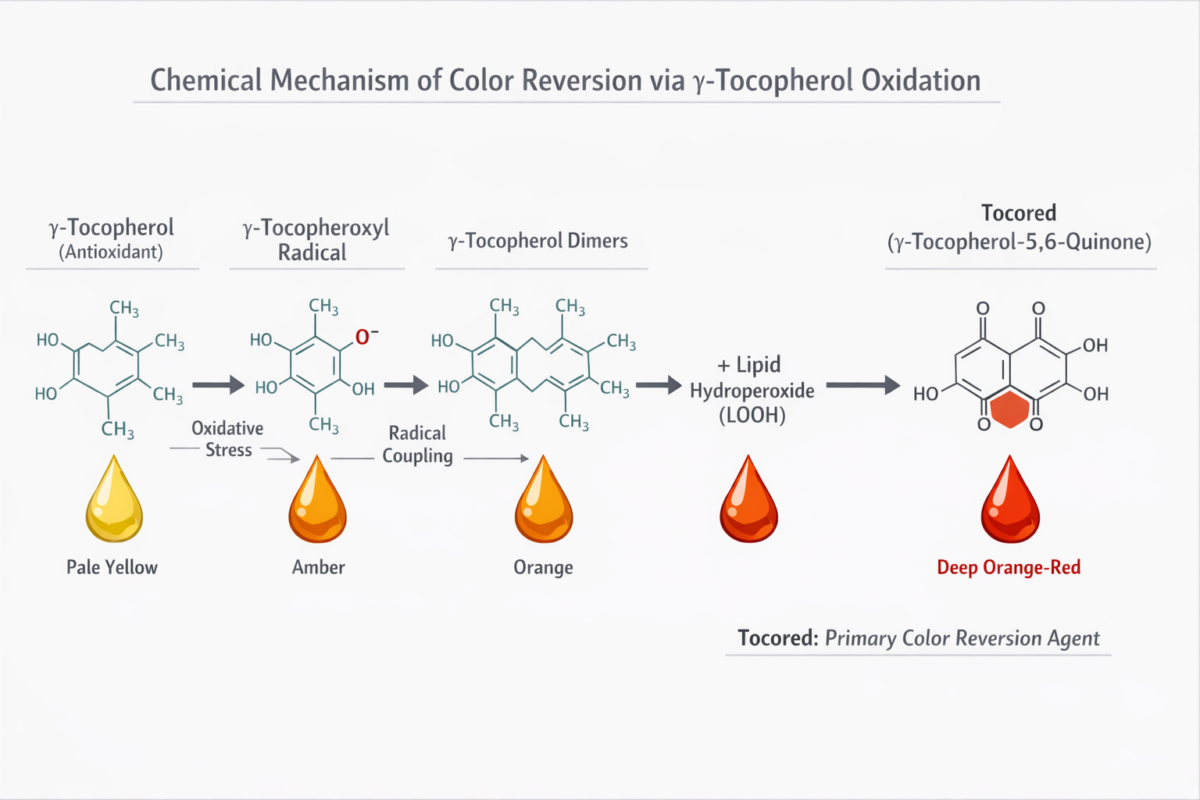
During lipid oxidation, γ-tocopherols donate a hydrogen atom to lipid peroxyl radicals (LOO•), thereby forming γ-tocopheroxyl radicals.
These radicals do not remain inert. Instead, they undergo secondary reactions, most notably biomolecular coupling, resulting in the formation of γ-tocopherols dimers such as γ-tocopheroxy-γ-tocopherol and γ-tocopheryl-γ-tocopherol.
Crucially, these dimers can further react with lipid hydroperoxides (LOOH), producing γ-tocopherol-5,6-quinone,commonly referred to as tocored.
Tocored is an ortho-quinone compound (C28H46O3; molecular weight 430.7) with strong chromophoric properties. At low concentration, tocored imparts a yellow hue, whereas higher concentrations generate a distinct orange-red coloration.
Even trace quantities can visibly alter oil color, which explains why refined oils may darken without showing advanced oxidative rancidity.
Experimental Evidence Supporting Tocored as the Color Reversion Agent:
Multiple experimental studies have conclusively demonstrated the central role of tocored in color reversion. Komoda and co-workers removed the unsaponifiable fraction where tocored concentrates from vegetable oil using molecular distillation.
The treated oil showed negligible color reversion compared with the untreated oil. When purified oil fractions were deliberately spiked with tocored and heated at 100°C, the oils developed intense red coloration proportional to the tocored concentration.
These experiments clearly established that tocored alone can reproduce the color reversion phenomenon, thereby identifying it as the primary color-forming substance.
More recent quantitative work by Atta and Al-Okaby (2022) traced tocored levels throughout the refining process. Crude soybean oil contained approximately 169.2 mg/kg tocored.
Conventional refining removed nearly 73% of this content, reducing tocored to around 8.46 mg/kg after bleaching. After deodorization, tocored became undetectable.
However, during subsequent storage, the deodorized oil developed 46.5 mg/kg tocored, confirming that a significant fraction of tocored had converted into a colorless precursor during refining and later reverted to the colored quinone form.
These findings support a two-step reversion model. First, refining transforms tocored into a non-chromophoric intermediate. Second, storage conditions enable this intermediate to re-oxidize back into tocored.
The proposed intermediate is often described as a quinone-methide-like structure, although its exact identity remains under investigation.
In summary, the γ-tocopherol → tocored pathway remains the cornerstone of color reversion chemistry. Any factor that accelerates tocopherol oxidation, such as heat, oxygen exposure, light, or metal catalysis, inevitably increases the risk of color reversion.
Role of Minor Components: Phospholipids and Metal Ions: Color reversion in edible oils.
Although phospholipids and metal ions constitute less than 1% of refined oil, their influence on color stability is disproportionately large.
Phospholipids as Pro-Color Reversion Agents
Residual phospholipids, commonly quantified as phosphorus content, exhibit a strong correlation with color reversion intensity. Oils with higher residual phosphorus levels after deodorization consistently show more pronounced color darkening during storage.
Experimental additions of lecithin (phosphatidylcholine) to model oils accelerate color development, confirming the pro-oxidant behavior of phospholipids.
Phospholipids contribute to color formation through multiple mechanisms:
- Thermal pyrolysis and browning: At deodorization temperatures (80-180 °C), phosphatidylethanolamine (PE) and phosphatidylcholine (PC) decompose into nitrogen-containing heterocycles, including pyrrole derivatives with strong yellow-brown coloration.
- Thermal degradation and polymerization: Heating isolated lecithin produces polyene polymers that absorb visible light, resulting in dark coloration.
- Pseudo-Maillard reactions: Residual sugars from oilseeds react with amino groups in PE to form pyridinium and related brown compounds, even at moderate refining temperatures.
- Oxidative condensation: Oxidized phospholipids react with aldehydes generated during lipid oxidation to form melanophosphatides, polymeric structures analogous to melanin pigments.
Because of these pathways, refiners aim to remove phospholipids as completely as possible. However, non-hydratable phospholipids (NHP), mainly calcium and magnesium salts of phosphatidic acids, often persist unless acid degumming is optimized.
Industry practice typically targets residual phosphorus below 5 mg/kg, with premium refined oils requiring levels closer to 1-2 mg/kg to ensure color stability.
Metal Ions and Their Catalytic Role:
Trace metal ions, particularly iron and copper, strongly accelerate color reversion despite their low concentration.
Crude oils may contain 2-15 mg/kg total metals, while refined oils generally contain less than 1mg/kg. Even at these low levels, metals exert several detrimental effects:
- Pro-oxidant catalysis: Metal ions catalyze the decomposition of lipid hydroperoxides into free radicals, accelerating tocopherol oxidation and tocored formation. Copper ions are especially potent, followed by ferric and ferrous iron.
- Pigment chelation and release: Metals can temporarily mask pigments by chelating them. When processing or storage conditions change, these complexes dissociate, leading to sudden color development.
- Iron soap formation: In oils with elevated free fatty acids, iron forms colored iron soaps, imparting a red-brown tint.
To mitigate these effects, refining operations rely on effective degumming, clay bleaching, and chelating agents such as citric acid to remove or immobilize metal ions.
Refining Process: Critical Steps Influencing color reversion in edible oils:
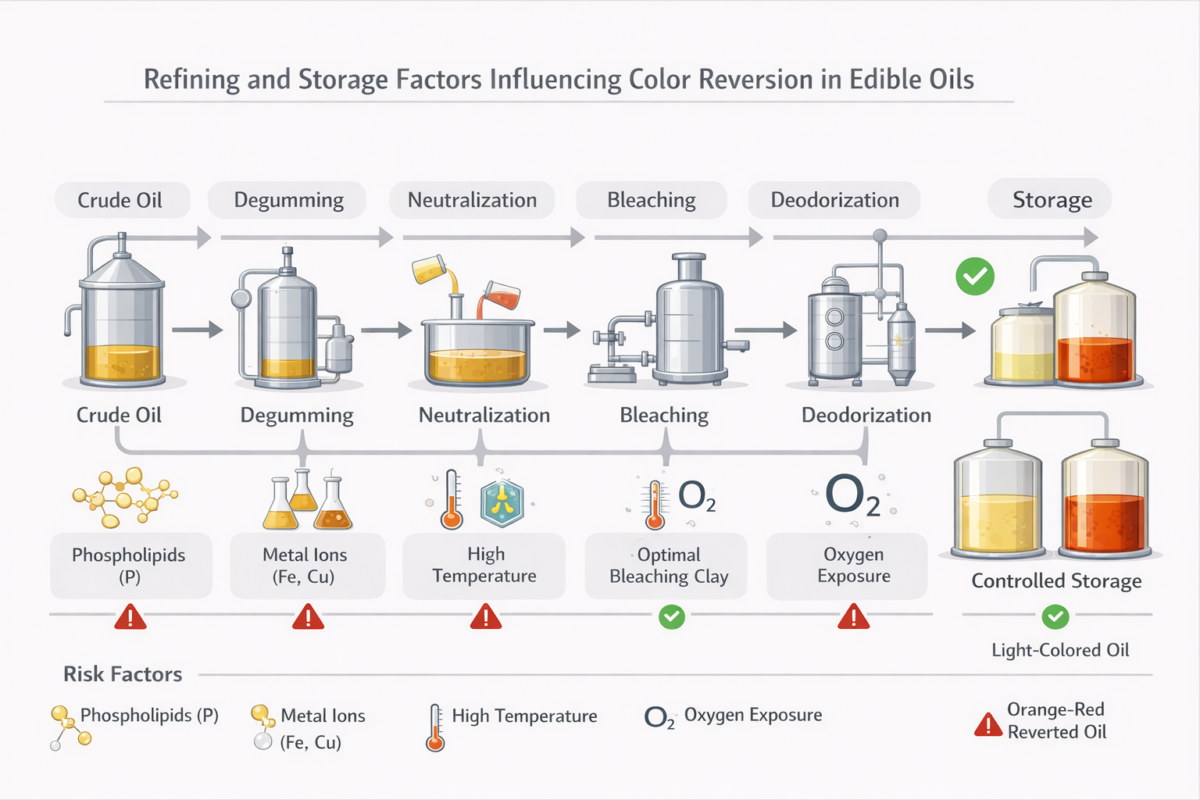
Each refining stage influences color reversion risk differently.
Degumming
Degumming removes hydratable phospholipids and converts NHP into forms using phosphoric or citric acid. Typical acid dosages range from 0.1 to 0.3% phosphoric acid or 0.1 to 1.0% citric acid.
Over- or under-dosing can either leave NHP behind or increase residual phosphorus. Best practice aims for <12 mg/kg phosphorus after degumming, <2 mg/kg after bleaching, and <1 mg/kg in the final oil.
Deacidification
Chemical refining neutralizes FFAs using sodium hydroxide. Insufficient alkali leaves pro-oxidant FFAs, while excessive alkali increases oil loss and residual soap.
Residual soap must be reduced below 40 mg/kg, as soaps catalyze peroxide breakdown and promote reversion.
Physical refining avoids alkali but requires extremely low phosphorus (<5 mg/kg) and a low initial FFA level. Any residual phospholipids under high-temperature deodorization can permanently fix color.
Bleaching
Bleaching removes pigments, soaps, and metals. However, excessively active acid-activated clays may catalyze oxidation or introduce trace metals.
Controlled clay activity (~50 mmol H+/kg) and low-metal clays such as attapulgite often yield better color stability.
Deodorization
Deodorization represents the most critical stage. High temperatures (220-250°C) and vacuum remove volatiles but also degrade tocopherols, particularly γ-tocopherol.
Effective control includes oxygen removal before deodorization, optimized time-temperature profiles, and rapid post-deodorization cooling below 45°C.
Dewaxing
Dewaxing affects turbidity rather than color and does not contribute significantly to color reversion.
Moderate Refining
Emerging evidence suggests that moderate refining, which preserves natural antioxidants while removing key impurities, can significantly reduce reversion risk compared with aggressive refining.
Storage Conditions and Antioxidant Strategies:
Storage temperature, light exposure, and oxygen availability strongly influence the kinetics of color reversion. A 15°C increase in temperature can quadruple color reversion rates.
Nitrogen blanketing, opaque packaging, and cool storage dramatically reduce reversion risk.
Antioxidants further enhance stability. TBHQ remains highly effective but faces regulatory and consumer resistance.
Ascorbyl palmitate, a natural antioxidant, has shown comparable efficacy by regenerating tocopherols and suppressing tocored formation. Combined antioxidant strategies often provide the best protection.
Conclusion and Industry Outlook:
Color reversion in edible oils primarily arises from γ-tocopherol oxidation to tocored, amplified by phospholipids, metal ions, refining severity, and storage conditions.
Effective control requires an integrated approach encompassing raw material quality, optimized refining, antioxidant preservation, and controlled storage.
While significant progress has been made, unresolved questions remain regarding tocored precursors and complex reaction pathways.
Continued research, combined with improved refining materials and predictive models, will further enhance color stability and extend the shelf life of refined edible oils.