

Frying oil undergoes chemical changes when exposed to high temperatures, oxygen, moisture, and food residues.
Thank you for reading this post, don't forget to subscribe!As these reactions continue, oxidation products, hydrolysis products, and polymerized substances accumulate, affecting the oil’s quality and frying performance.
Total Polar Compounds (TPC) provide an important indicator of the deterioration of used frying oil. Their measurement helps food manufacturers, restaurants, snack producers, and quality-control laboratories monitor oil condition and determine when replacement is necessary.
In practical quality control, an ATAGO DOM-24 Frying Oil Monitor can provide rapid measurements of Total Polar Compounds-related polar material through its displayed Total Polar Materials (TPM%) value.
Laboratory chromatography offers a different analytical approach by separating and quantifying the polar fraction.
Understanding the difference between these methods, fresh-oil baseline readings, and applicable discard limits is essential for interpreting results correctly.
What are Total Polar Compounds in Frying Oil?
Fresh, refined vegetable oil consists mainly of triacylglycerols, which are molecules formed from glycerol and three fatty acids. During frying, heat, oxygen, and moisture contribute to chemical reactions that change the original oil molecules and produce substances with different polar characteristics.
The resulting polar fraction may contain:
- Oxidized triacylglycerols and other oxygen-containing products.
- Diacylglycerols and monoacylglycerols formed during hydrolysis.
- Free fatty acids released from triacylglycerols.
- Dimers and oligomers produced through thermal and oxidative reactions.
- Other polar substances associated with oil processing, storage, or deterioration.
The proportion of these substances generally increases as frying continues, although the rate depends on the oil type and operating conditions.
Total Polar Compounds therefore represent a broad measure of chemical alteration rather than a measurement of one particular compound. The value cannot identify individual degradation products or independently establish every aspect of oil quality.
Oxidation and Thermal Reactions
Unsaturated fatty acids react with oxygen through lipid-oxidation pathways. Initial reactions produce hydroperoxides, which are unstable at frying temperatures and decompose into secondary products.
These reactions can generate:
- Aldehydes and ketones.
- Other oxygen-containing compounds.
- Oxidized triacylglycerols.
- Higher-molecular-weight products formed through subsequent reactions.
Some products remain in the oil and contribute to the polar fraction, while others undergo further decomposition or react to form larger molecules.
This is one reason peroxide value cannot be used alone to determine the condition of repeatedly heated oil.
Hydroperoxides can decompose at high temperatures, so a low peroxide value does not necessarily indicate limited deterioration.
Hydrolysis Caused by Moisture
Water released from food enters hot oil during frying. It promotes hydrolysis of the ester bonds in triacylglycerols, producing partial glycerides and free fatty acids.
The extent of hydrolysis depends on factors such as:
- Moisture content of the food.
- Duration and temperature of frying.
- Oil circulation and contact with food.
- Frequency of oil replenishment.
Free fatty acids may increase during frying, but their concentration does not represent the entire polar fraction. Other degradation products can accumulate even when the increase in free fatty acids is relatively modest.
Polymerization and Accumulation of Degradation Products
At elevated temperatures, certain oxidized lipid molecules react with each other to form dimers and larger oligomers. These products may contribute to increased viscosity, sticky deposits, and deterioration of frying performance.
As oxidation, hydrolysis, and thermal reactions continue, Total Polar Compounds can accumulate at different rates in different oils.
High-oleic oils and palm olein may behave differently from oils rich in polyunsaturated fatty acids, but no oil should be considered immune to deterioration.
Testing Total Polar Compounds: Laboratory and Instrumental Methods
Two practical approaches are commonly used to evaluate the polar fraction of frying oils: laboratory separation and rapid measurement with an oil-quality monitor.
The selection depends on whether the objective is routine process monitoring, laboratory confirmation, or demonstrating compliance with a specified analytical method.
Laboratory Determination by Silica-Gel Chromatography
ISO 8420:2002 describes a method for determining polar compounds in animal and vegetable fats and oils. Read the official ISO 8420 description.
In the chromatography-based approach, the oil sample is separated into polar and predominantly nonpolar fractions using an appropriate adsorbent and specified solvents.
The general analytical workflow includes:
- Prepare a representative oil sample according to the selected method.
- Weigh the required quantity of sample.
- Apply the prepared sample to a silica-gel column.
- Separate the fractions using the method-specified solvent system.
- Remove solvents under the prescribed conditions.
- Determine the relevant fraction masses and calculate the polar content.
- Verify the method’s quality-control requirements.
The exact sample mass, solvent composition, column preparation, recovery requirements, and calculation procedure must follow the adopted method. The simplified calculation below should not replace the complete standard procedure.
Example Calculation of Total Polar Compounds
For a method that calculates the polar fraction by subtracting the recovered nonpolar fraction from the initial sample mass:
Formula
TPC (%) = [(Initial sample mass − Recovered nonpolar fraction mass) ÷ Initial sample mass] × 100
Where:
- Initial sample mass = mass of the original oil sample, in grams.
- Recovered nonpolar fraction mass = mass of the nonpolar fraction recovered after separation, in grams.
Worked Example
Suppose:
- Initial sample mass = 1.00 g
- Recovered nonpolar fraction mass = 0.76 g
Step 1: Calculate the difference.
1.00 − 0.76 = 0.24 g
Step 2: Divide the difference by the initial sample mass.
0.24 ÷ 1.00 = 0.24
Step 3: Convert the result into a percentage.
0.24 × 100 = 24%
Final result: TPC = 24%
This calculation assumes that the analytical method determines polar content by subtracting the recovered nonpolar fraction from the initial sample mass. Follow the calculation specified in your laboratory’s approved test method.
This example assumes suitable fraction recovery and separation. Incomplete separation, residual solvent, moisture, and weighing errors can affect the result.
Rapid Testing with the ATAGO DOM-24
For routine frying-oil monitoring, the ATAGO DOM-24 Frying Oil Monitor provides a convenient instrumental alternative to conventional chromatography.
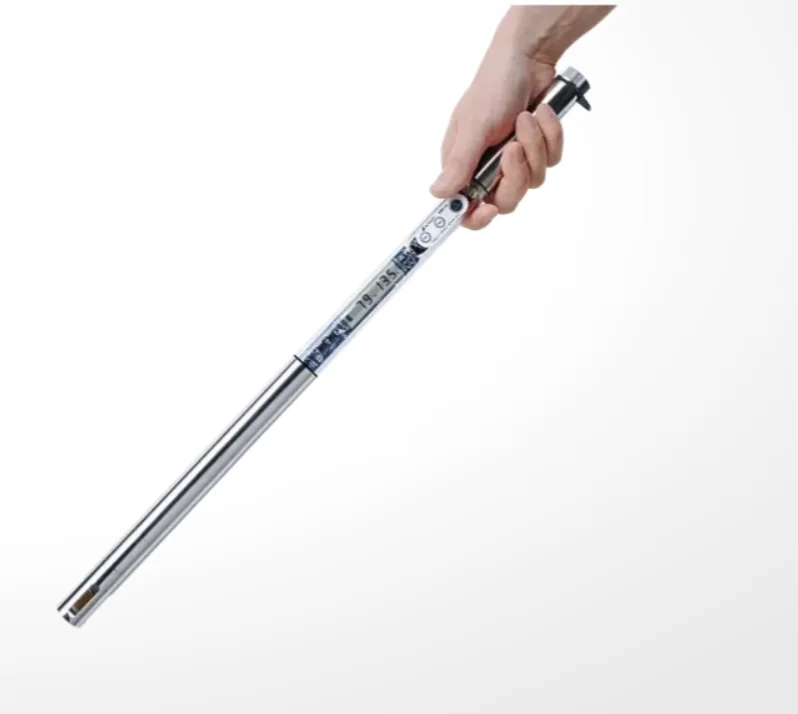
According to the official ATAGO DOM-24 product information, the instrument measures electrical properties and temperature, then calculates the displayed TPM percentage using a correlation between those measurements. It does not physically separate and weigh the polar fraction.
This distinction matters because the instrumental result and laboratory chromatography result are not automatically interchangeable.
ATAGO DOM-24 Specifications
| Parameter | Manufacturer’s specification |
|---|---|
| Instrument | ATAGO DOM-24 Frying Oil Monitor |
| TPM measurement range | 0.5–40.0% |
| TPM resolution | 0.5 percentage points |
| Stated TPM accuracy | ±2.0% |
| Recommended TPM measurement temperature | 80–200°C |
| Temperature measurement range | 0–225°C |
| Acid Value (AV) display range | 0.00–9.99 |
| Acid Value resolution | 0.01 |
| Acid Value stated accuracy | ±0.2 |
| Protection rating | IP67 |
| Typical measurement time | Approximately 30 seconds |
Source: ATAGO official product information. Specifications should be confirmed against the manual supplied with the instrument.
The stated accuracy and recommended measurement temperature should be considered when evaluating a result close to an action limit.
TPM resolution describes the displayed increment, whereas accuracy describes the manufacturer’s stated measurement performance.
Practical Testing Procedure
Follow the manufacturer’s instructions and your laboratory’s approved procedure for consistent measurements.
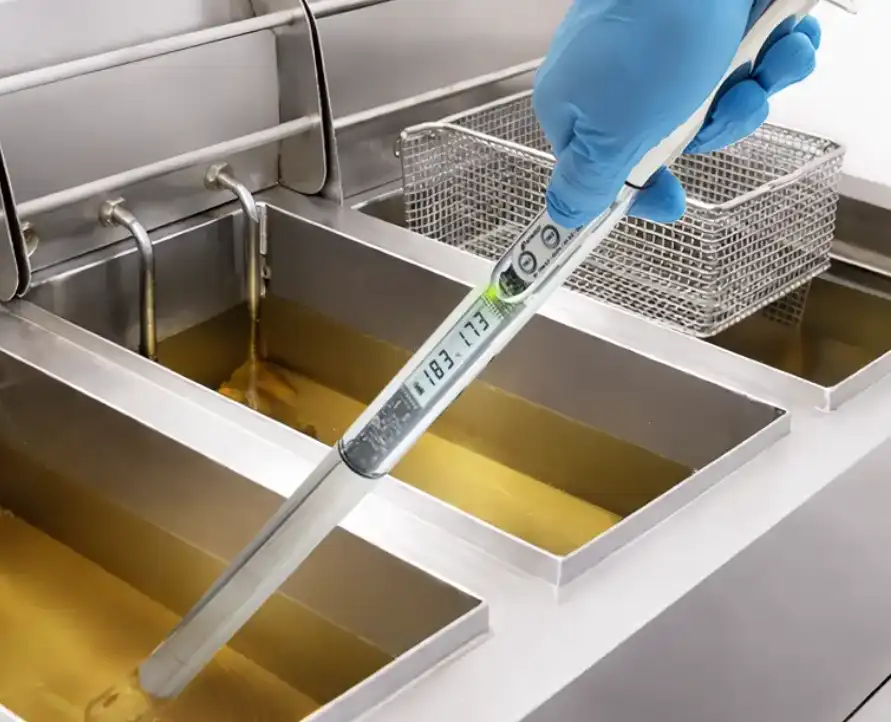
- Prepare the sample or fryer. Ensure that the oil being tested is representative of the batch or fryer under assessment.
- Inspect the instrument. Check its condition, battery status, sensor cleanliness, and any required verification checks.
- Measure the oil. Immerse the sensor to the specified depth without exceeding the permitted immersion marking.
- Allow the reading to stabilize. Follow the instrument’s operating instructions and note the temperature at measurement.
- Record the result. Document the TPM value, temperature, date, time, fryer identification, oil type, and sampling conditions.
- Clean the sensor. Follow the manufacturer’s cleaning instructions to prevent carry-over between samples.
- Compare with the applicable limit. Use the documented regulatory or internal acceptance criterion.
The DOM-24 incorporates automatic temperature compensation, but its specified accuracy applies under the manufacturer’s stated conditions. Measurement capability across a broad temperature range should not be interpreted as identical accuracy at every temperature.
The device also displays Acid Value. ATAGO calculates this display using a correlation rather than directly performing a conventional acid-value titration.
Where a specified titration method is required, the displayed estimate must not automatically replace the reference-method result.
Fresh-Oil Baselines and Total Polar Compounds Readings
Fresh-oil testing establishes a baseline against which changes during frying can be evaluated. In practical checks using the same type of ATAGO monitor, fresh conventional cooking oils have been observed at approximately 0–4% TPM, while fresh palm olein has shown readings around 0–5%.
These are practical observations, not universal specifications or manufacturer-guaranteed ranges.
| Oil condition | Observed TPM reading | Interpretation |
|---|---|---|
| Fresh conventional cooking oils | Approximately 0–4% | Practical baseline observed during testing |
| Fresh palm olein | Approximately 0–5% | Practical baseline observed during testing |
| Oil being used for frying | Usually rises as degradation accumulates | Monitor the trend and compare it with the applicable limit |
| Oil approaching the discard limit | Close to the specified action point | Review the trend and prepare for corrective action |
| Oil exceeding an applicable 20% maximum | Above the specified limit | Apply the required discard procedure where that limit applies |
Important instrument limitation: The DOM-24’s specified TPM measurement range begins at 0.5%, with a resolution of 0.5 percentage points. Consequently, a recorded value of zero should not be treated as a validated quantitative measurement below the manufacturer’s specified range.
Confirm the displayed result and applicable instrument instructions before reporting it as an exact value.
The starting baseline is useful, but it is not sufficient by itself. Consistent sampling and tracking the change during frying are necessary for meaningful interpretation.
What Is the 20% Discard Limit for Total Polar Compounds?
The 20% maximum is explicitly listed in the Punjab Pure Food Regulations, 2018, under Section 02.6, Oils/Fats During Frying. Read the official Punjab Pure Food Regulations, 2018 (PDF) for Appendix I, Section 02.6.
However, the distinction between an analytical standard and a legal requirement is important:
- ISO 8420:2002 specifies an analytical method for determining polar compounds.
- Punjab Pure Food Regulations, 2018 explicitly specify a 20% maximum for frying oil within their jurisdiction.
- Other jurisdictions may establish different limits or apply additional conditions.
- An internal company specification may set an earlier alert level to support proactive oil management.
Therefore, 20% should not be described as a universal limit mandated by every international standard. It is a defined requirement in the Punjab regulation cited above and should be applied where legally relevant.
The Punjab regulation also lists a maximum free fatty acid content of 1.8% and trans fatty acids of 5% for oil during frying. These are separate requirements: meeting the polar-content limit does not automatically establish compliance with every other criterion.
For practical monitoring, consider the following:
- Establish an internal alert point below the applicable maximum, based on validated measurement performance and operational needs.
- Increase attention to results as they approach the limit.
- Investigate unexpected or borderline readings.
- Apply the required discard procedure when the applicable regulatory limit is exceeded.
- Do not rely solely on the number of frying cycles.
Comparing Total Polar Compounds With Other Oil Quality Tests
No single result describes every chemical change occurring in frying oil. Combining suitable tests can provide a more complete understanding of deterioration.
| Test | Main characteristic measured | Important limitation |
|---|---|---|
| Total Polar Compounds | Aggregate polar fraction, including many degradation products | Does not identify every compound individually |
| Free fatty acids (FFA) or acid value | Free fatty acids associated with hydrolysis and other processes | Does not quantify the entire polar fraction |
| Peroxide value (PV) | Primary oxidation products, especially hydroperoxides | Hydroperoxides decompose at frying temperatures |
| Anisidine value (AnV) | Certain secondary oxidation products, particularly aldehydes | Does not measure all degradation products |
| Colour and viscosity | Physical changes accompanying deterioration | Food residues, pigments, and other factors may also affect readings |
For additional laboratory context, see VegOilScience’s guides to free fatty acid determination and anisidine value in edible oils.
The key distinction is that the polar fraction represents a broad category of material, while FFA, PV, and AnV focus on particular chemical characteristics. The results may therefore change at different rates without necessarily contradicting one another.
Troubleshooting and Quality Control for Total Polar Compounds Testing
An unexpected reading should not automatically be interpreted as a sudden change in oil chemistry. Sampling errors, temperature differences, instrument condition, and nonuniform oil can all affect the observed result.
| Observation | Possible explanation | Recommended action |
|---|---|---|
| Fresh-oil reading is higher than usual | Different oil composition, previous handling, sampling variation, or instrument issues | Check the oil identity, fresh-oil baseline, sensor condition, and repeatability |
| Reading increases rapidly | Prolonged heating, high temperature, moisture, or food residues | Review operating history and process controls |
| Readings differ between instruments | Instrument variation, measurement conditions, or calibration and verification differences | Compare using a documented verification procedure |
| Reading is close to 20% | Oil is approaching a relevant action point, subject to measurement uncertainty | Follow the approved escalation and verification procedure |
| Appearance is poor, but reading is relatively low | Food pigments, burnt residues, or changes not fully represented by TPM | Investigate other quality indicators and product requirements |
Quality-Control Practices for Reliable Results
For reliable testing, quality-control teams should:
- Take representative samples at defined intervals.
- Use consistent measurement conditions wherever practical.
- Record oil temperature and operating history with each result.
- Maintain the instrument according to the manufacturer’s instructions.
- Check suspicious or borderline results using an appropriate verification method.
- Retain results to identify trends and support replacement decisions.
Controlling Oil Deterioration During Frying
The formation of polar degradation products cannot be completely eliminated during frying, but appropriate practices can slow their accumulation.
- Control temperature: Avoid overheating and unnecessary hot holding.
- Limit prolonged exposure: Switch off or reduce heating when appropriate for the production process.
- Remove food residues: Use suitable filtration to reduce crumbs and suspended particles.
- Manage moisture: Apply appropriate food-preparation and frying practices.
- Select an appropriate oil: Select an appropriate oil: Fatty acid composition influences oxidative stability. See the VegOilScience guide to palm olein frying performance.
- Manage replenishment carefully: Fresh oil can dilute the measured polar fraction but does not reverse degradation already present.
- Maintain clear acceptance criteria: Apply legal requirements and internal quality limits consistently.
Colour and odour can provide useful warning signs, but neither should replace appropriate testing. Likewise, adding fresh oil should not be used to circumvent an applicable discard limit.
Conclusion
Total Polar Compounds testing is a valuable component of frying-oil quality control. Laboratory chromatography provides an established separation-based method, while the ATAGO DOM-24 offers rapid instrumental monitoring through its TPM reading.
Establishing fresh-oil baselines, maintaining consistent measurement procedures, and tracking changes during frying make results more useful. The 20% discard criterion must be applied in accordance with the relevant regulation rather than presented as a universal ISO requirement.
The practical rule is simple: monitor oil throughout its use, investigate unexpected results, consider measurement limitations, and replace the oil when the applicable regulatory or internal quality criteria require it.
References and Technical Sources
- ATAGO Co., Ltd. DOM-24 Frying Oil Monitor: operating principle and specifications. Manufacturer information on TPM range, resolution, accuracy, temperature compensation, and the instrument’s measurement principle.
- International Organization for Standardization. ISO 8420:2002 — Animal and vegetable fats and oils: Determination of content of polar compounds. Official description of the analytical method.
- Punjab Food Authority, Government of Punjab. Punjab Pure Food Regulations, 2018. Appendix I, Section 02.6, Oils/Fats During Frying, specifies total polar compounds not more than 20% within the scope of the regulation.
Frequently Asked Questions
1. Why are Total Polar Compounds measured in frying oil?
They provide a broad indicator of deterioration resulting from oxidation, hydrolysis, and thermal reactions. The result supports monitoring and oil-replacement decisions.
2. What TPM reading is expected for fresh cooking oil?
Practical observations with the specified monitor have shown approximately 0–4% for conventional cooking oils and 0–5% for palm olein. These are observed ranges, not universal specifications. The DOM-24’s specified measurement range begins at 0.5%.
3. Is 20% the universal international discard limit?
No. The Punjab Pure Food Regulations, 2018, explicitly specify a maximum of 20% total polar contents for oil during frying. ISO 8420:2002 describes the analytical method; it does not establish a universal discard limit for all countries.
4. Can the ATAGO DOM-24 replace laboratory analysis?
It can support rapid routine monitoring, but its measurement principle differs from laboratory chromatography. Confirmatory testing may be necessary when required by a specification, regulatory procedure, or internal quality system.
5. Can fresh oil be added to reduce the TPM reading?
Yes, replenishment can dilute the polar-material concentration. However, it does not reverse all chemical changes in used oil and must not be used to bypass a discard requirement.
6. Does a low TPM reading guarantee good oil quality?
No. Other issues, including contamination, off-flavours, excessive foaming, and failures against separate quality criteria, may justify corrective action even when the TPM reading is below the applicable limit.

Leave a Comment