

The Chemical Refining Process is an industrial method for converting crude vegetable oil into a cleaner, more stable edible oil. It uses an alkaline solution, usually sodium hydroxide (caustic soda), to neutralize free fatty acids (FFA), then removes the resulting soapstock and other impurities through separation, washing, bleaching, filtration, and deodorization.
Thank you for reading this post, don't forget to subscribe!The exact sequence depends on the oil type, feed quality, equipment design, and finished-product specification.
A refinery aims to meet quality and food-safety requirements while minimizing neutral-oil losses, chemical and water consumption, effluent, and damage to desirable minor components such as tocopherols and phytosterols.
A robust Chemical Refining Process therefore begins with representative feed testing and continues through verified controls at every downstream stage. This guide explains the main stages, process controls, laboratory checks, troubleshooting priorities, and the differences between chemical and physical refining.
- Quality objective: remove unwanted FFA, gums, pigments, residual soap, moisture, and volatile compounds to meet the applicable product specification.
- Yield objective: limit neutral oil carried into soapstock, spent bleaching earth, and other side streams.
- Operating objective: control chemicals, water, heat, vacuum, and separation conditions using measured feed data and validated plant procedures.
What Is the Chemical Refining Process?
In the Chemical Refining Process, free fatty acids react with an alkali and form soap. The soap is separated from the neutral oil, generally by centrifugal separation in continuous plants.
The oil then receives further treatment to reduce residual soap, phospholipids, pigments, trace metals, moisture, and compounds responsible for unwanted taste or odour.
Chemical refining is used for many vegetable oils, including soybean, sunflower, canola, and cottonseed oil. Physical refining removes most FFA through steam distillation during deodorization. Neither route is automatically best for every feedstock: oil quality, phosphorus content, equipment, yield, side-stream value, utilities, and finished-oil requirements determine the suitable route.
The selected Chemical Refining Process should be assessed against the actual feed profile and final specification rather than copied unchanged from another plant. See the American Oil Chemists’ Society (AOCS) resources on oil refining and alkali refining.
- Crude-oil preparation establishes the incoming quality and removes coarse solids.
- Degumming or conditioning reduces phospholipids and prepares gums for separation.
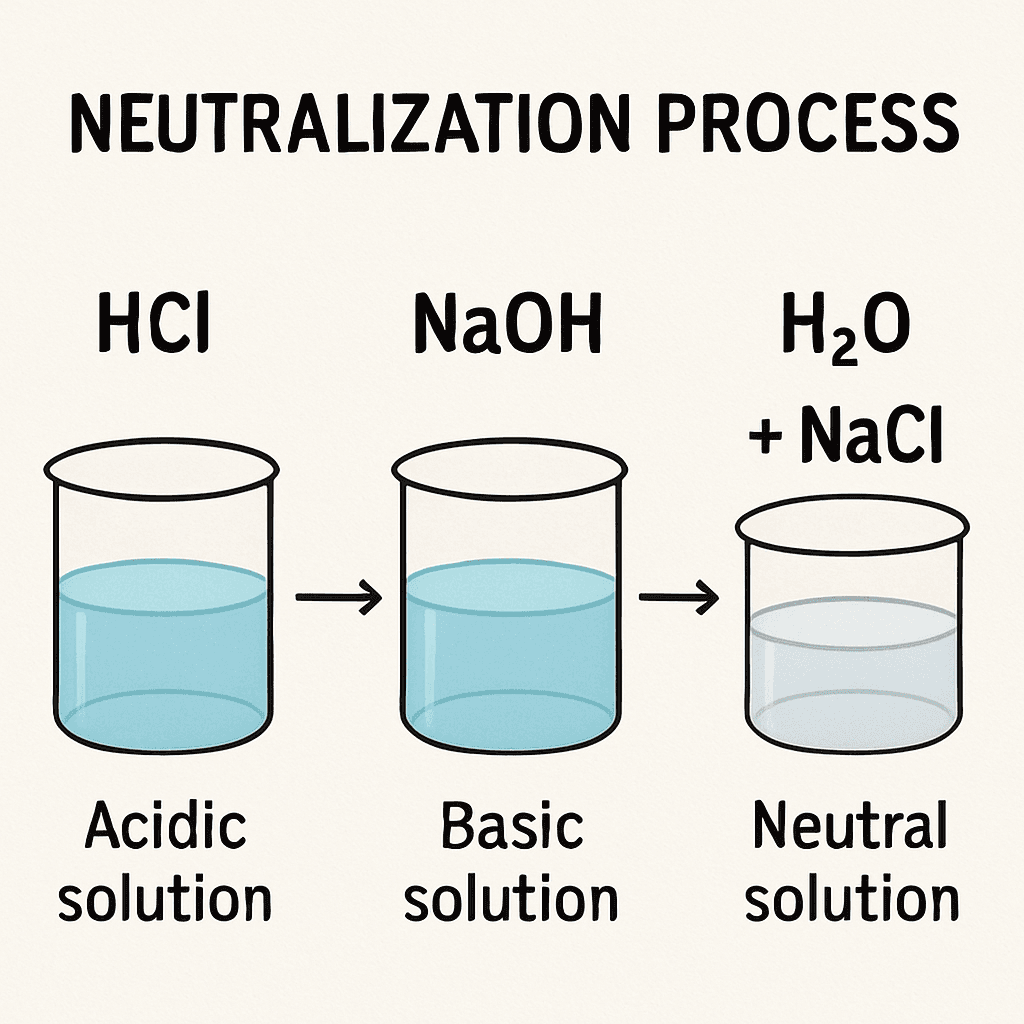
- Caustic neutralization converts FFA into soap that can be removed from the oil.
- Washing, drying and bleaching lower residual soap, moisture, pigments, and other impurities.
- Deodorization uses steam and vacuum to remove volatile compounds and remaining FFA.
The Chemistry Behind Neutralization
A free fatty acid reacts with sodium hydroxide to form a sodium fatty-acid salt (soap) and water:
Free fatty acid + sodium hydroxide (NaOH) → sodium soap + water
Soap transfers into the aqueous or soapstock phase, allowing the oil and heavier phase to be separated. Some neutral oil can become entrained in soapstock; excess alkali, high gum content, unsuitable mixing, or unstable separation can increase losses.
The Chemical Refining Process also removes some phospholipids, metals, pigments, and oxidation-related compounds, but it cannot fully reverse deterioration that occurred before the oil reached the refinery.
- Use the measured FFA result and its reporting basis when calculating the theoretical neutralization requirement.
- Confirm the actual strength and density of the caustic solution before converting a pure-NaOH requirement into a working-solution dose.
- Account for process-specific excess alkali, other acidic components, feed variation, and the approved operating recipe.
- Review both oil quality and neutral-oil losses; a low FFA result alone does not prove that neutralization is efficient.
Main Stages of the Chemical Refining Process
The Chemical Refining Process is easier to control when every unit operation has a defined purpose, a representative sampling point, and a measurable output.
A written process map helps operators connect each stage with its incoming material, expected outlet condition, and response when results move outside the normal range. The sequence below is typical, but some plants combine, omit, or add stages to suit the oil and process design.
| Stage | Main purpose | Useful control point |
|---|---|---|
| Crude-oil preparation | Remove coarse solids and establish feed quality | FFA/acid value, moisture, impurities, phosphorus |
| Degumming or conditioning | Reduce phospholipids and prepare gums for separation | Acid/water dosage, mixing, phosphorus after treatment |
| Caustic neutralization | Convert free fatty acids into soap | Caustic strength and flow, temperature, mixing, residual FFA |
| Separation and washing | Remove soapstock and residual soap | Separator performance, soap, oil in soapstock, wash-water quality |
| Drying and bleaching | Reduce moisture and adsorb pigments and impurities | Moisture, adsorbent, temperature, vacuum and colour |
| Filtration | Remove spent adsorbent and suspended solids | Flow, differential pressure, clarity and cycle time |
| Deodorization | Strip volatile odour compounds and residual FFA | Vacuum, temperature, steam, residence time and quality results |
| Dewaxing, when required | Reduce haze at low storage or use temperatures | Cooling profile, crystallization and filtration |
1. Crude-Oil Receiving, Storage and Filtration
Before treatment, verify oil identity, tank status, line suitability, and sampling records. Crude oil may contain seed fines, moisture, gums, metals, and storage-related degradation products. Good feed control sets the starting point for the Chemical Refining Process.
- Test FFA or acid value, moisture, and insoluble impurities using the plant’s approved sampling and analytical methods.
- Measure phosphorus, colour, and oxidation indicators where they are relevant to the oil type and refining route.
- Record the tank, batch or lot, temperature, flow, supplier, and receipt date so laboratory results can be traced to the feed.
- Use a suitable strainer or filter to protect pumps, meters, mixers, and separators from coarse solids.
- Keep tanks, transfer lines, and sampling tools clean; avoid unnecessary exposure to air, heat, moisture, and prolonged storage.
A strainer protects equipment but does not replace proper degumming or removal of dissolved and finely dispersed impurities. This receiving-stage gate helps the Chemical Refining Process start from reliable data and reduces the risk of treating a feed change as an unexplained downstream failure.
Where feed quality changes substantially, review the process recipe rather than assuming that the previous settings remain suitable.
2. Degumming and Acid Conditioning
Degumming removes phospholipids, commonly called gums. Some phospholipids hydrate when water is added; others are non-hydratable because they are associated with calcium or magnesium.
Depending on crude-oil composition, water, phosphoric acid, citric acid, or a combination of treatments may be used to condition gums for separation.
The Chemical Refining Process may use a dedicated degumming stage or remove some gums during neutralization. The sequence depends on phosphorus content, oil type, separator design, and yield targets.
Poor degumming can increase soapstock losses, emulsion formation, bleaching demand, and filter blockage. An efficient Chemical Refining Process uses the phosphorus result to verify treatment performance and understand the likely cause of downstream instability.
- Measure incoming phosphorus and review historical feed variation before setting the treatment recipe.
- Verify acid concentration, metering-pump calibration, dosing rate, and chemical identity.
- Confirm mixing intensity, contact time, any required water addition, and the designed separation conditions.
- Test treated oil at the defined sampling point and compare the result with the validated plant target.
- Investigate rising phosphorus together with colour, soap, filtration pressure, and neutral-oil loss rather than changing acid dosage in isolation.
For a deeper discussion of phosphorus measurement and process decisions, read Phosphorus Content in Edible Oils: Testing Methods and Refinery Control.
3. Caustic Neutralization
Neutralization is the defining operation in chemical refining. Sodium hydroxide is dosed to react with FFA; an appropriate excess may also be needed to account for feed variation and other acidic components.
Dosage depends on measured FFA and its reporting basis, alkali concentration, oil type, and the validated procedure. These variables must be controlled together in the Chemical Refining Process.
- Verify the FFA result, reporting basis, oil throughput, caustic concentration, and actual metering rate.
- Confirm that the alkali is mixed and distributed as intended without creating excessive soap dispersion or promoting avoidable neutral-oil saponification.
- Maintain the approved temperature, mixing intensity, and contact time for the particular oil and equipment design.
- Sample after neutralization and separation; review residual FFA, soap, phase stability, and oil carried into soapstock.
- Do not correct high residual FFA by increasing caustic blindly: first rule out sampling, concentration, flow, mixing, and separation errors.
Illustrative calculation: 1,000 kg of oil at 0.50% FFA, expressed as oleic acid, contains about 5 kg of FFA on that basis. The theoretical pure-NaOH equivalent is:
5 kg × (40/282.47) = approximately 0.71 kg pure NaOH
This is a stoichiometric illustration, not a plant dosing recommendation. In a controlled Chemical Refining Process, the calculated requirement is translated into a working dose only after the actual caustic concentration, excess alkali, other acidic components, feed variation, and validated operating procedure have been considered. See the detailed caustic soda calculation guide for oil neutralization.
4. Soapstock Separation and Oil Washing
A centrifuge separates soapstock from neutralized oil. Soapstock contains soaps, water, gums, impurities, and some entrained neutral oil; its composition can help explain refining losses. Track this stream as part of the Chemical Refining Process yield balance.
- Monitor separator stability, oil and heavy-phase discharge, throughput, and any signs of interface or phase-separation problems.
- Check residual soap after separation and after washing using the method and reporting basis specified by the laboratory.
- Verify wash-water quality, temperature, flow, and distribution against the plant’s validated procedure.
- Check moisture after washing and confirm that the drying stage can handle the remaining water load.
- Where practical, measure neutral oil in soapstock and use the result with chemical consumption and throughput to assess yield.
Too little washing may leave residual soap, while excessive water or poor phase separation can increase wastewater, form emulsions, and cause oil losses.
When soap remains high, investigate caustic excess, feed gums, mixing, centrifuge operation, and wash-water conditions before increasing water automatically. This avoids using extra water to mask a separation problem within the Chemical Refining Process. See Soap Content in Refined Oil: Testing Method, Causes and Control.
5. Drying and Bleaching
Washed oil is dried as needed before bleaching. Excess moisture can reduce bleaching efficiency and contribute to filtration difficulties.
During bleaching, hot oil contacts an adsorbent, often acid-activated bleaching earth, to remove pigments, residual soaps, phospholipids, trace metals, and some oxidation products. Silica or activated carbon may be selected for particular contaminants or process goals.
- Confirm that the adsorbent grade is approved for the oil and the intended treatment objective.
- Control adsorbent dosage, oil temperature, contact time, mixing, moisture, and vacuum in line with the validated process.
- Trend colour before and after bleaching; investigate abnormal results alongside phosphorus, soap, feed quality, and adsorbent condition.
- Ensure spent adsorbent is removed completely and safely through the designated filtration system.
- Review oil retained in spent earth where possible; excessive adsorbent use can raise cost and oil loss without proportionate quality improvement.
More bleaching earth is not always better. Dosage should reflect feed quality, target specification, equipment capability, and the outcome of controlled trials.
In the Chemical Refining Process, bleaching should be optimized using measured colour and relevant impurity results, not colour alone. AOCS explains key variables in its bleaching-process optimization resource.
6. Filtration and Polishing
Filtration removes spent adsorbent and suspended solids. Differential pressure, flow, clarity, cake condition, and cycle time indicate consistency.
In the Chemical Refining Process, effective filtration protects downstream equipment and helps prevent visible particles or adsorbent carryover into finished oil.
- Trend differential pressure and cycle duration instead of relying only on the final filtrate appearance.
- Check for excess moisture, fines, unsuitable adsorbent, gum or soap carryover, damaged filter media, and poor pre-coating.
- Follow equipment pressure limits and the approved isolation procedure before inspecting a filter or opening a housing.
- Use a polishing filter where required by the plant design or product specification.
- Protect filtered oil from recontamination through clean, dry lines, tanks, transfer hoses, and filling equipment.
Do not increase operating pressure beyond equipment limits to compensate for an unexplained rise in resistance. Identify the cause, document the corrective action, and confirm that performance has returned to the normal range.
7. Deodorization Under Vacuum
Deodorization uses steam at elevated temperature and reduced pressure to remove volatile odour and flavour compounds and residual FFA.
Temperature, pressure, residence time, steam rate, and equipment design interact, so settings must match the oil and specification. See the AOCS deodorization resource.
- Trend actual vacuum, oil temperature, steam flow, residence time, and deodorizer throughput.
- Check odour and flavour results alongside FFA or acid value and other finished-oil requirements.
- Avoid unnecessary heat exposure; excessive temperature or holding time may reduce desirable minor components and increase process-contaminant risks.
- Review the design and operating conditions used to reduce 3-MCPD esters and glycidyl esters, particularly where the oil or process presents elevated risk.
- Keep records that connect deodorizer settings to oil type, feed history, finished-oil results, and any deviations.
Contaminant mitigation requires control across the supply chain; deodorization is not the only control. The Codex Alimentarius Code of Practice CXC 79-2019 gives guidance for reducing 3-MCPD esters and glycidyl esters in refined oils and foods made with refined oils.
The Chemical Refining Process should therefore balance stripping performance with thermal exposure and the site’s risk-based controls. Operating windows should be established for the particular deodorizer and product, then reviewed when the oil source, throughput, or product specification changes.
8. Dewaxing, Cooling and Storage
Some oils, particularly sunflower and corn oils, may need dewaxing or winterization to prevent haze at low temperatures.
The oil is cooled under controlled conditions, so waxes or other high-melting components crystallize and can be removed by filtration. Whether this stage is needed depends on the oil, intended use, and clarity specification.
- Apply the validated cooling profile and provide sufficient crystallization time for the oil and equipment design.
- Confirm that filtration removes the crystals without unacceptable oil retention or flow problems.
- Cool the finished oil and make only approved post-treatment additions, if specified.
- Transfer the product to clean, dry, suitable storage tanks and maintain lot identity and traceability.
- Limit avoidable exposure to oxygen, heat, light, water, and contaminants; rotate stock using the site’s FIFO procedure.
Chemical vs Physical Refining
Both methods aim to produce oil that meets the required specification, but they remove FFA differently. Chemical refining neutralizes FFA with alkali and separates the resulting soapstock.
Physical refining removes most FFA by distillation during deodorization. Selection should be based on the feedstock, quality requirements, process design, yield balance, utilities, and management of side streams.
| Comparison point | Chemical refining | Physical refining |
|---|---|---|
| Main FFA-removal step | Alkali neutralization; FFA are converted into soap | Steam distillation/deacidification during deodorization |
| Main side stream | Soapstock containing soap, water, impurities, and entrained oil | FFA-rich deodorizer distillate |
| Feed preparation | Degumming/conditioning and neutralization are central operations | Effective degumming and low phosphorus are particularly important |
| Potential neutral-oil loss | Can rise through soapstock entrainment and excessive caustic | May reduce neutralization-related loss, but overall yield depends on feed and conditions |
| Key operating focus | Caustic dosing, mixing, separation, washing, bleaching and soap control | Degumming, phosphorus control, deodorizer performance and contaminant mitigation |
| Route selection | Useful for many oils and a range of crude-oil qualities | Suitable when feed quality and process conditions support physical refining |
- Compare total refining loss, not one isolated process stream or a single laboratory result.
- Include chemical use, water, steam, power, effluent treatment, side-stream recovery, and maintenance in the cost assessment.
- Confirm that the chosen route can consistently achieve the product’s quality and food-safety requirements with the available equipment.
Yield, Utilities and Production Records
Yield should be evaluated across a defined production period using a consistent mass-balance method. Compare oil entering the line with refined oil, soapstock, spent bleaching earth, filter residues, samples, transfers, and any other accounted streams.
Avoid comparing batches unless the measurement boundaries and inventory corrections are consistent. Where the balance does not close within the site’s acceptance range, check tank levels, flowmeter calibration, transfer timing, and the basis used for weighing or estimating side streams.
Utilities and operating consumables should be trended with production throughput. Record caustic, conditioning chemicals, wash water, bleaching earth, steam, electricity, and effluent volume per tonne of oil where the site can measure them reliably.
These indicators do not replace product testing; they help identify changes that may explain rising cost, water demand, filtration time, or neutral-oil loss. Establish a baseline for each oil and process route, because values from different feeds may not be directly comparable.
Each production record should connect the oil lot to its laboratory results, approved recipe, actual chemical use, critical operating parameters, deviations, corrective actions, and release decision.
When a setting is changed, document who authorized it, why it was changed, and whether later results confirm sustained improvement. These records make troubleshooting reproducible and support an evidence-based review of the Chemical Refining Process instead of relying on memory or isolated results.
A consistent dashboard helps the Chemical Refining Process team compare quality, yield, and resource use across comparable runs.
Process Control: What Should Operators and the Laboratory Monitor?
Manage the Chemical Refining Process through trends at defined sampling points rather than relying on the final test alone.
Use representative samples, calibrated equipment, traceable analytical methods, and plant-defined action limits. Specifications and process targets vary by oil, process route, customer, and market; the values used by one refinery should not automatically be treated as universal limits.
| Sampling point | Useful checks | What an unexpected result may indicate |
|---|---|---|
| Crude oil | FFA/acid value, moisture, impurities, phosphorus, colour and selected oxidation indicators | Variable feed quality, hydrolysis, storage deterioration or sampling/cleaning problems |
| After degumming/conditioning | Phosphorus, separation behaviour and visible gums | Inadequate conditioning, incorrect dosage, insufficient contact or poor separation |
| After neutralization/separation | FFA, soap, oil in soapstock and phase stability | Caustic-dose or strength error, poor mixing, separator upset or high gum load |
| After washing/drying | Soap, moisture and clarity | Incomplete washing, emulsion, inadequate drying or poor phase separation |
| After bleaching/filtration | Colour, soap, phosphorus where applicable, clarity and pressure trend | Adsorbent problem, high moisture, filtration issue or contaminant carryover |
| Final refined oil | Sensory properties, colour, FFA/acid value, moisture/volatile matter, soap and phosphorus as specified; PV where meaningful | Upstream process failure, heat damage, oxidation, recontamination or unsuitable storage |
- Use an approved sampling plan that defines the sample point, flushing procedure, container, frequency, and sample identification.
- Report results with consistent units and a clearly stated basis; acid value is commonly expressed as mg KOH/g oil, while FFA is a percentage based on a specified fatty-acid equivalent.
- Interpret peroxide value as an indicator of primary oxidation, not as a complete measure of all secondary oxidation products or overall oil condition.
- Review calibration, blanks, duplicates, control samples, and method suitability before changing plant settings in response to an unexpected result.
- Link laboratory results to batch identity, tank, process stage, operating conditions, and material balance so that trends support a specific decision.
For broader laboratory and process-quality context, see the VegOilScience guide to edible-oil processing and quality control.
Common Operating Problems and Corrective Checks
Use a structured investigation to find the likely cause before adjusting the recipe. The Chemical Refining Process is interconnected: changing one variable can affect soap formation, separation, water use, yield, bleaching, and finished-oil quality.
| Problem | Checks to prioritize | Follow-up confirmation |
|---|---|---|
| High FFA after neutralization | FFA basis, caustic strength and flow, oil throughput, mixing, temperature, contact time, and separator performance | Repeat the approved test and confirm the outlet result after a controlled correction |
| High residual soap after washing | Caustic excess, incoming gums, wash-water quality/flow, emulsions and centrifuge operation | Retest soap and moisture at the defined outlet point |
| High phosphorus after degumming | Incoming phosphorus, acid/water treatment, mixing, contact time, separation and possible treatment-derived carryover | Confirm the analytical result, then compare with the validated process target |
| Dark colour after bleaching | Feed colour, adsorbent grade and condition, dosage, moisture, time, temperature and vacuum | Trend colour and related quality results after the controlled adjustment |
| Slow filtration or high pressure | Moisture, fines, filter media, cake condition, adsorbent selection, soap/gum carryover and operating limits | Verify flow, clarity, pressure trend and cycle time |
| Poor odour or flavour after deodorization | Vacuum, steam, temperature, residence time, feed quality and possible downstream contamination | Confirm sensory and relevant laboratory tests against the product specification |
| Unexpectedly low yield | Neutral oil in soapstock and spent earth, tank reconciliation, flowmeter checks, separator performance and chemical over-dosing | Reconcile the mass balance across a representative production period |
- Confirm the abnormal result before making a large operating adjustment; sample identity or analytical error can imitate a process problem.
- Check recent changes in oil source, feed quality, production rate, chemical batch, water supply, maintenance, and operator settings.
- Change one controllable variable at a time where practical, and document the reason, setpoint, result, and approval.
- Verify sustained performance after the adjustment; do not close a corrective action based on one favourable sample alone.
- Revise an SOP only after the investigation shows that the change is safe, repeatable, documented, and approved by the responsible technical authority.
Practical Takeaway
The Chemical Refining Process works best when feed quality, dosing, mixing, separation, washing, drying, bleaching, filtration, and deodorization are controlled as one connected system.
The target is not simply to remove impurities: the refinery must also protect neutral-oil yield, control utilities and effluent, and consistently meet the applicable finished-oil specification.
- Start with reliable feed measurements and representative sampling.
- Use validated recipes based on oil type, measured feed quality, and equipment capability.
- Track FFA, phosphorus, soap, moisture, colour, filtration behaviour, and yield at defined process points.
- Investigate abnormal results systematically before increasing chemicals, water, adsorbent, or heat.
- Keep traceable records so laboratory results and production data support continual improvement.
References and Further Reading
- AOCS — Oil Refining: overview of chemical and physical refining and the main impurity-removal steps.
- AOCS — Alkali Refining: neutralization chemistry, soapstock separation, and operating considerations.
- AOCS — Optimization of Bleaching Process: factors affecting adsorption and bleaching performance.
- AOCS — Deodorization: deodorization purpose and process variables.
- FAO/WHO Codex Alimentarius — CXC 79-2019: code of practice for reducing 3-MCPD esters and glycidyl esters in refined oils and foods made with refined oils.
FAQs
What chemicals are used in the Chemical Refining Process?
Sodium hydroxide is the principal neutralizing alkali. Water and, where required by the validated process, phosphoric or citric acid may be used during degumming or conditioning. Bleaching earth, silica, and activated carbon are adsorbents selected according to the oil and treatment objective. Chemical identity, concentration, and dosage must follow an approved procedure.
Is chemical refining better than physical refining?
Neither route is universally better. Chemical refining creates soapstock during alkali neutralization, while physical refining removes most FFA through steam distillation during deodorization. Feed quality, phosphorus, yield, equipment, utility costs, by-product value, contaminant controls, and product specifications determine the suitable route.
Why is soap found in refined oil after washing?
Residual soap can result from excess caustic, high gum content, poor centrifuge separation, emulsion formation, ineffective washing, or unsuitable operating conditions. Confirm the laboratory result and review the process from neutralization onward before increasing bleaching-earth dosage; adsorbent addition does not replace correcting poor washing or separation.
What quality tests are most important?
Common checks include FFA or acid value, phosphorus, soap, moisture, colour, sensory properties, and selected oxidation indicators. Additional testing depends on oil type, process route, customer requirements, and market. No single test proves complete compliance, so results must be assessed against the applicable specification and validated control plan.
Does deodorization remove every contaminant?
No. Deodorization is effective for many volatile compounds, but not every contaminant is volatile or removed equally. Some process contaminants may form under certain refining conditions. Use risk-based controls across feed selection, degumming, bleaching, deodorization, and post-refining handling, and follow the applicable regulatory and customer requirements.


Comments are closed.