


In edible-oil refining, caustic soda is used to neutralize free fatty acids (FFA) so they can be separated from the oil as soapstock. The basic Caustic soda calculation estimates the theoretical active sodium hydroxide (NaOH) requirement from the oil mass and FFA result.
Thank you for reading this post, don't forget to subscribe!The working dose must then account for the refinery’s approved caustic excess, verified solution strength, and any additional acid introduced during pretreatment. A complete Caustic soda calculation therefore separates chemical demand from dilution and flow control.
Theoretical active NaOH (kg) = Oil mass (kg) × FFA (%) ÷ 100 × 0.1416
This factor applies when FFA is reported as oleic acid. It gives the stoichiometric requirement before excess; it is not, by itself, a production setpoint.
1. What the FFA formula means
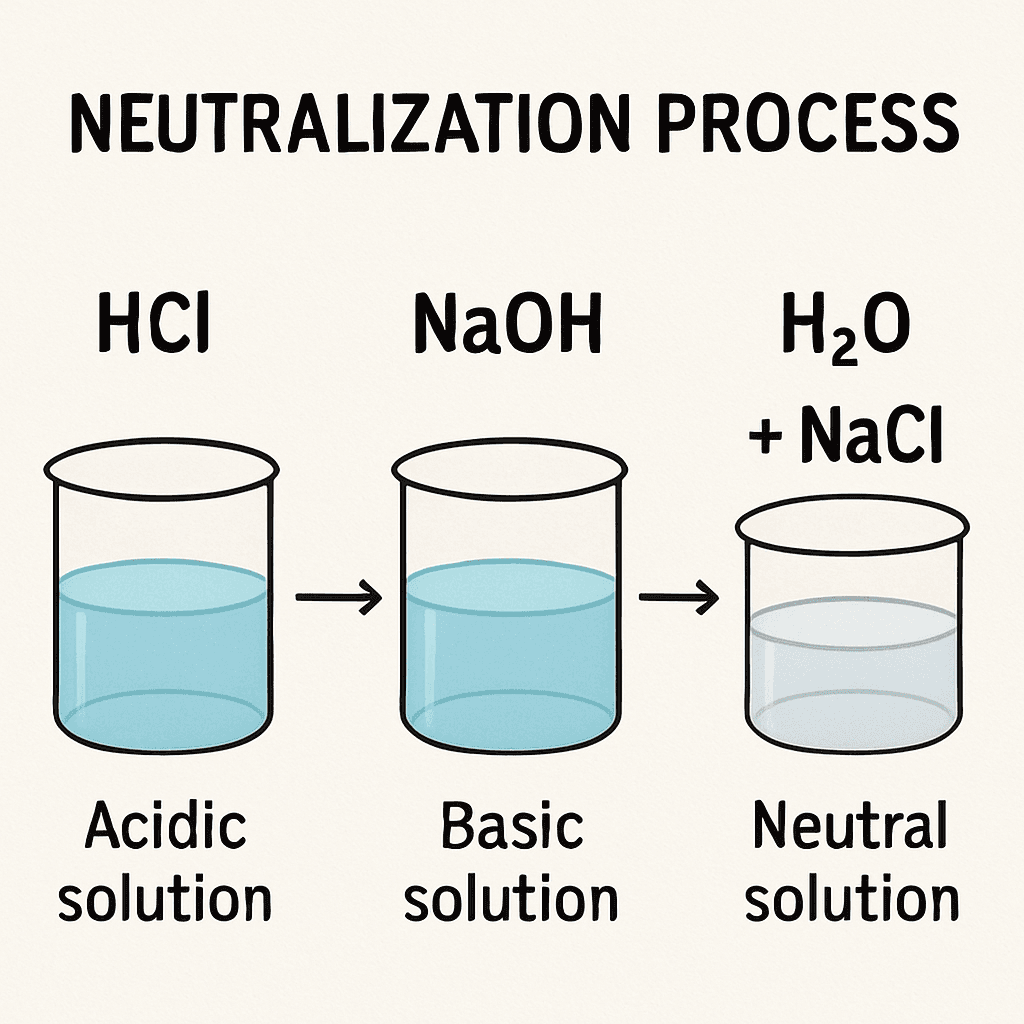
During alkaline neutralization, NaOH reacts with free fatty acids to form sodium soaps and water. The soap-rich phase is removed from the oil, commonly in a centrifugal separator. As described in the AOCS guide to alkali refining, caustic quantity and concentration are selected according to feed quality and process requirements.
A reliable Caustic soda calculation begins with the right analytical result and keeps theoretical demand separate from the plant’s approved operating adjustment. In practical terms, the Caustic soda calculation is a material balance built around a defined FFA basis.
The simplified reaction is:
R–COOH + NaOH → R–COONa + H₂O
One mole of NaOH reacts with one mole of a monocarboxylic fatty acid. The molecular mass of NaOH is about 40.00 g/mol, while oleic acid is about 282.46 g/mol. Their ratio is 40.00 ÷ 282.46 ≈ 0.1416. For this reason, each kilogram of FFA expressed as oleic acid requires theoretically about 0.1416 kg of pure NaOH.
- Before performing the Caustic soda calculation, verify the basis of the laboratory result:
- FFA percentage expressed as oleic acid.
- FFA percentage expressed on another fatty-acid basis.
- Acid value.
- Record the confirmed reporting basis in every Caustic soda calculation worksheet.
- Remember that FFA percentage and acid value are related but cannot be used interchangeably without the appropriate conversion.
2. Formula variables and units
Use consistent mass units throughout the worksheet. A batch calculation may use kilograms, while a continuous plant may use tonnes per hour; both oil and caustic flows must be expressed on the same time basis.
| Variable | Formula or meaning | Important note |
| FFA mass (kg) | Oil mass × FFA (%) ÷ 100 | Assumes a mass percentage |
| Theoretical active NaOH (kg) | FFA mass × 0.1416 | FFA expressed as oleic acid |
| Active NaOH after excess | Theoretical NaOH × (1 + excess fraction) | Use the approved plant factor |
| Working solution mass (kg) | Active NaOH ÷ NaOH mass fraction | Example: use 0.1437 for 14.37% w/w |
For a Caustic soda calculation per metric tonne of oil, the shortcut is:
Theoretical active NaOH (kg/t) = 1.416 × FFA (%)
Here, enter the reported percentage as a number: use 1.5 for 1.5% FFA. In the full batch formula, divide the percentage by 100. This difference in format is a frequent source of spreadsheet errors.
To make the Caustic soda calculation auditable, show the percentage input, conversion to a fraction, and final active-NaOH result in separate cells.
Keep these quantities distinct in the record:
- Theoretical active NaOH: calculated from FFA only.
- Excess-adjusted active NaOH: theoretical demand multiplied by the approved excess factor.
- Working solution mass: active NaOH divided by the solution’s verified NaOH mass fraction.
- Dilution water: separately calculated when concentrated caustic is diluted for process use.
3. Worked FFA example for a 20-tonne batch
Assume a batch contains 20,000 kg of oil with 2.4% FFA as oleic acid. For illustration, use a plant-approved caustic excess of 15% and working solution assayed at 32% NaOH. The excess is illustrative only; actual values depend on the oil, equipment, pretreatment, and validated recipe.
- Calculate FFA mass: 20,000 × 2.4 ÷ 100 = 480 kg.
- Calculate theoretical NaOH: 480 × 0.1416 = 67.97 kg active NaOH.
- Apply excess: 67.97 × 1.15 = 78.16 kg active NaOH.
- Convert to 32% solution: 78.16 ÷ 0.32 = 244.25 kg working solution.
Conversion Chart
| Stage | Calculation | Result |
| FFA mass | 20,000 × 2.4 ÷ 100 | 480 kg |
| Theoretical NaOH | 480 × 0.1416 | 67.97 kg |
| NaOH after 15% excess | 67.97 × 1.15 | 78.16 kg |
| 32% solution mass | 78.16 ÷ 0.32 | 244.25 kg |
This Caustic soda calculation excludes any additional alkali required to neutralize phosphoric or citric acid added during pretreatment. The Caustic soda calculation should identify these adjustments separately so they can be checked against the process recipe.
If those acids are used, their demand must be included according to the approved procedure rather than hidden in an unexplained FFA adjustment.
4. Diluting 50°Bé caustic to working strength
Many edible-oil refineries receive concentrated liquid caustic soda, often specified commercially as about 50% NaOH or described as approximately 50° Baumé (°Bé).
These labels are not strictly identical: Baumé is a density scale, not a direct weight-percent measurement. A commonly used reference table at 15.56°C (60°F) places 50°Bé near 49.02% NaOH by weight, with a density near 1.525 kg/L. See the NaOH density and Baumé reference table.
- Check the supplier’s Certificate of Analysis (COA) to confirm the actual NaOH concentration.
- Measure the caustic solution’s density and apply the appropriate temperature correction.
- Use the refinery’s approved Baumé (°Bé) conversion chart to determine the working concentration.
- Do not assume that a solution labelled 50% caustic soda is exactly 50°Bé, as weight percentage and Baumé are different measurements.
- Base the dilution and Caustic soda calculation on the verified stock concentration whenever this information is available.
Dilution Formula
For dilution by mass:
Water to add (kg) = Stock caustic mass (kg) × [(Stock NaOH fraction ÷ Target NaOH fraction) − 1]
For the chart below, the stock is assumed to be 50°Bé at the reference temperature, approximately 49.02% w/w NaOH (0.4902). Keep the stock assumption visible in the Caustic soda calculation rather than burying it in a formula constant. The target percentage is the approximate NaOH mass fraction associated with the selected Baumé reading.
For example, the dilution water for a 20°Bé target is:
Water = Stock mass × [(0.4902 ÷ 0.1437) − 1]
The result is approximately 2.41 kg water for each 1 kg of the assumed 50°Bé stock. This dilution step is separate from the oil-side Caustic soda calculation, which determines the amount of working solution to dose.
50°Bé dilution chart
| Target strength | Approx. NaOH (% w/w) | Water per 1 kg of 50°Bé stock | Water per 100 kg stock | Approx. water per 1 L of stock |
| 30°Bé | 23.67% | 1.07 kg | 107 kg | 1.63 L |
| 25°Bé | 18.58% | 1.64 kg | 164 kg | 2.50 L |
| 20°Bé | 14.37% | 2.41 kg | 241 kg | 3.68 L |
| 15°Bé | 10.06% | 3.87 kg | 387 kg | 5.91 L |
| 10°Bé | 6.55% | 6.48 kg | 648 kg | 9.89 L |
The litre-based figures assume stock density of approximately 1.525 kg/L and water density of approximately 1 kg/L. They show the approximate volume of water added per litre of stock, not the final solution volume; volumes are not perfectly additive. Concentrations and density also change with temperature.
Treat the table as a planning guide and verify the prepared solution with a calibrated Baumé hydrometer or a suitable concentration method at the instrument’s reference temperature. Use the measured strength when completing the Caustic soda calculation for a production batch.
A 50% w/w stock assay differs slightly from the 49.02% w/w value assumed in this table. If the certificate confirms 50.0% NaOH, replace 0.4902 with 0.5000 in the equation and recalculate the water. Do not mix stock assumptions within a single Caustic soda calculation.
Example: making 20°Bé solution from 100 kg of stock
Using the table assumptions:
- Active NaOH in stock = 100 × 0.4902 = 49.02 kg.
- Total solution mass at 14.37% NaOH = 49.02 ÷ 0.1437 ≈ 341.1 kg.
- Water to add = 341.1 − 100 ≈ 241.1 kg.
Therefore, about 241 kg of water is required per 100 kg of the specified 50°Bé stock to obtain a solution near 20°Bé at the reference conditions. Recalculate this dilution and caustic soda calculation if the delivered assay differs from the assumed value.
Dilution releases considerable heat. It must be performed in an engineered dilution system under the site’s approved procedure, with suitable agitation, temperature control, and chemical-resistant PPE.
As a general chemical-handling rule, add concentrated caustic slowly to water—not water into concentrated caustic—and follow the refinery’s written dilution sequence.
5. How FFA controls the dose at 20°Bé
Concentration and dosage are different operating variables. Concentration describes how strong the working solution is; dosage describes how much of it enters the oil. In many refining plants, 20°Bé is a normal working strength, and the quantity supplied is adjusted in line with the measured FFA and approved recipe.
A higher FFA usually increases the theoretical NaOH demand, while lower FFA reduces it. This is why the Caustic soda calculation should be refreshed when the feed quality changes. Increasing the concentration is not automatically the right response to higher FFA.
- The AOCS describes caustic dosing as a function of the following factors:
- Free fatty acid (FFA) content of the crude oil.
- Oil throughput.
- Pretreatment acids used during processing.
- Desired process excess of caustic soda.
- The Caustic soda calculation should be based on:
- Current laboratory results.
- Validated plant operating parameters.
- Actual oil characteristics and processing requirements.
- Avoid using an arbitrary dosing rule that treats every type of crude oil the same way.
Example: canola, soybean, or sunflower oil at 0.4% FFA
| Step | Calculation | Result |
| Assumptions | Crude canola, soybean oil (SBO), or sunflower oil (SFO); oil quantity = 1,000 kg; FFA = 0.4% as oleic acid; caustic solution = 20°Bé (approximately 14.37% NaOH by weight) | — |
| 1. FFA mass | 1,000 × 0.4 ÷ 100 | 4 kg |
| 2. Theoretical active NaOH | 4 × 0.1416 | 0.5664 kg |
| 3. Theoretical 20°Bé caustic solution | 0.5664 ÷ 0.1437 | Approximately 3.94 kg per ton of oil |
Note: This is the theoretical NaOH requirement based on FFA neutralization only. Actual refinery dosing may differ depending on operating conditions and the approved process excess.
This is the theoretical requirement only. The actual process dose may be higher because of approved caustic excess and additional acid demand.
Oils with the same FFA result and the same reporting basis have a similar theoretical alkali demand per ton, but their practical refining recipes may differ because of gums, other acidic compounds, impurity loads, and separation behavior. Do not use this example as a universal setpoint.
Use it to verify the arithmetic of your local Caustic soda calculation, then apply the approved excess and control strategy.
For routine operation:
- Use representative samples and the latest approved FFA result.
- Keep working strength at the validated setpoint unless the recipe authorizes a change.
- Adjust the solution flow in line with oil throughput, FFA, and approved excess.
- Review residual soap, neutral-oil loss, and separator performance after a recipe change.
6. What happens when caustic reacts with triglycerides?
The desired reaction is neutralization of free fatty acids:
R–COOH + NaOH → R–COONa + H₂O
The sodium salt is soap, which transfers into the soapstock phase during separation. However, caustic can also hydrolyze neutral triglycerides through saponification. Complete saponification is represented by:
Triglyceride + 3NaOH → Glycerol + 3 fatty-acid sodium salts
This side reaction consumes neutral oil and produces additional soap. The review Refining Vegetable Oils: Chemical and Physical Refining discusses both FFA neutralization and unwanted saponification, which can lower yield when conditions or dosage are poorly controlled.
- This risk is particularly important when FFA is low, as excessive alkali relative to the actual acid demand may increase neutral-oil loss without improving refining efficiency.
- A sound Caustic soda calculation helps establish the appropriate starting dose.
- Effective refining also requires proper mixing, reaction control, and efficient separation.
- A Caustic soda calculation cannot compensate for poor separation or inadequate sampling.
7. Laboratory checks and common mistakes
Before approving a dose, confirm the following:
- Analytical basis: verify that the result is FFA percentage as oleic acid, not acid value or a percentage on another basis.
- Concentration: verify stock assay and the final working strength at the correct reference temperature.
- Units: do not mix tons and kilograms, or confuse percentage points with decimal fractions.
- Other acids: include phosphoric or citric acid demand if used in the approved process.
- Process performance: investigate residual soap, emulsions, separation quality, and neutral-oil loss before increasing alkali.
- Traceability: record sample ID, oil mass or flow, FFA, stock assay, target °Bé, excess basis, calculated solution rate, and approval.
A common error is entering 0.4 instead of 0.004 in the full mass formula. Another is treating 20°Bé as 20% NaOH; in the reference chart, it is approximately 14.37% w/w.
The Caustic soda calculation worksheet should keep percentage formats and intermediate results visible so the operator and checker can identify mistakes. A reviewed Caustic soda calculation should also preserve the original laboratory result and any approved excess factor.
Acid value can be converted approximately to FFA as oleic acid using FFA (%) ≈ acid value × 0.503. Convert the result before calculating NaOH demand, and follow the laboratory’s documented method and reporting basis. This keeps the acid-value conversion traceable within the Caustic soda calculation record.
Conclusion
Use FFA to estimate theoretical active NaOH, apply the approved excess, and convert the result using verified caustic concentration. Document each stage of the Caustic soda calculation so the laboratory, production team, and checker can follow the same basis.
For dilution, treat °Bé as a density-based scale and confirm the working solution after mixing. A well-controlled Caustic soda calculation, combined with reliable laboratory results and monitoring of soap and oil losses, supports consistent neutralization without unnecessary chemical use.
For related reading, see VegOilScience’s guide to reducing neutralization and bleaching losses.
FAQs
How much active NaOH is needed for 1% FFA?
For FFA reported as oleic acid, the theoretical demand is about 1.416 kg active NaOH per metric tonne of oil, before excess and other acid demand. This shortcut is a quick check on the full Caustic soda calculation. The Caustic soda calculation remains a theoretical baseline until the site’s approved excess and process conditions are applied.
Does 20°Bé mean 20% NaOH?
No. At the reference temperature used in the chart, 20°Bé corresponds to approximately 14.37% NaOH by weight. This conversion is a crucial part of the Caustic soda calculation when working lye is specified in degrees Baumé. Confirm the actual solution against the refinery’s calibrated instrument and conversion table.
Should caustic strength increase when FFA increases?
Not necessarily. Many plants maintain a validated working strength and adjust the quantity dosed. Any concentration change should follow the approved oil-specific recipe.
Why can too much caustic increase refining loss?
Besides neutralizing FFA, excess alkali can promote triglyceride saponification and increase soapstock. Oil may also be entrained in the soapstock phase, reducing yield.
Can the same formula be used for all vegetable oils?
The stoichiometric factor applies when FFA is consistently expressed as oleic acid. Process excess, pretreatment requirements, and practical conditions may differ by oil and plant.

Leave a Comment