
Introduction
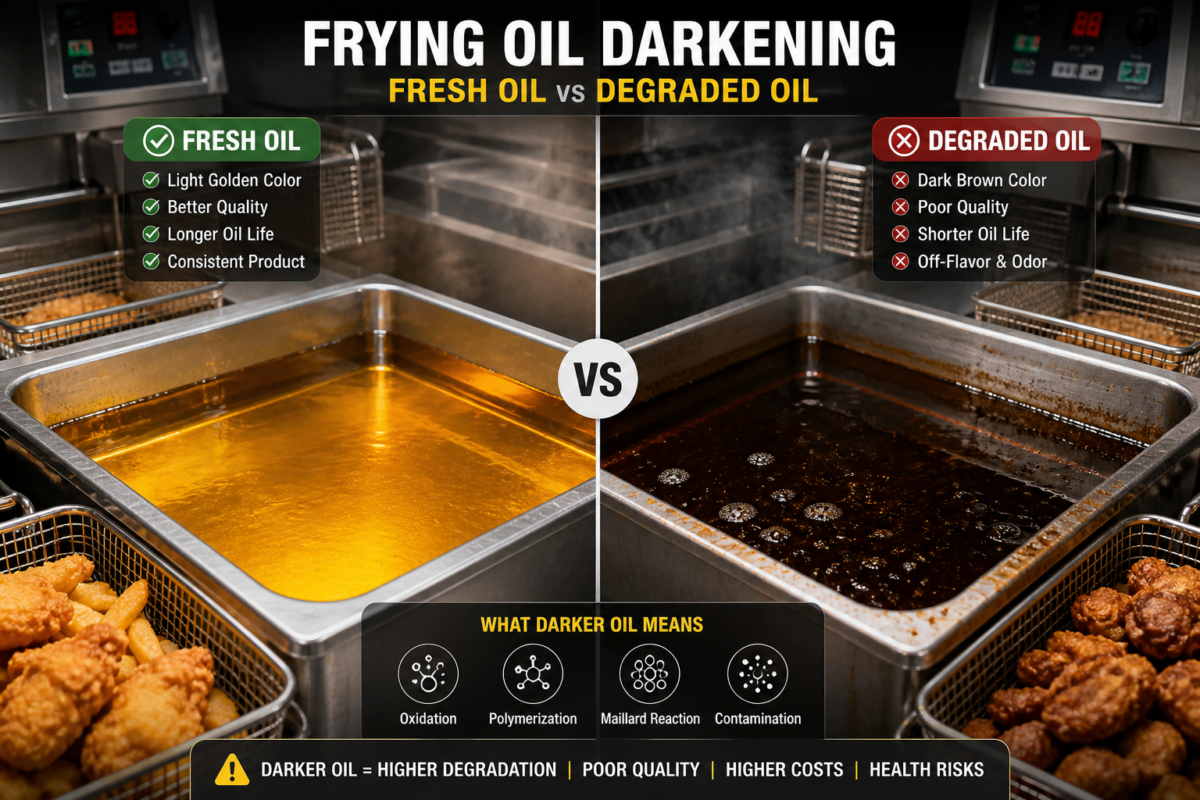
Frying oil darkening is one of the clearest indicators of oil degradation in industrial frying systems. While many operators still treat it as a visual issue, it actually reflects deep chemical changes occurring in the oil.
Thank you for reading this post, don't forget to subscribe!During frying, oil continuously interacts with heat, oxygen, moisture, and food residues. As a result, several reactions, oxidation, polymerization, and Maillard browning, occur simultaneously. Consequently, the oil gradually changes from light yellow to dark brown.
More importantly, this transformation affects not only appearance but also stability, product quality, and operational cost. Therefore, understanding frying oil darkening is essential for quality managers and process engineers.
What is frying oil darkening?
Frying oil darkening refers to the progressive color deterioration of oil during repeated heating cycles. Although the color change appears gradual, it indicates the accumulation of degradation compounds.
In practice, this process starts early and accelerates over time. Initially, the oil looks slightly darker. However, as degradation continues, the color deepens and becomes irreversible.
Key observations in industrial frying
- color shifts from yellow to dark brown
- oil becomes more viscous
- sticky residues from the fryer surface
- The product color becomes inconsistent
These changes directly impact production efficiency and product acceptance.
Causes of frying oil darkening
The darkening process does not result from a single factor. Instead, multiple mechanisms contribute simultaneously. Understanding these causes allows for better control strategies.
Frying oil darkening from thermal oxidation
Thermal oxidation is the determined mechanism. When oil is exposed to high temperatures, the presence of oxygen, a free radical reaction begins. These reactions generate secondary compounds such as aldehydes and ketones, which are responsible for color formation.
As temperature increases, oxidation accelerates significantly; even a small temperature rise can double the reaction rate. Therefore, strict temperature control is critical in frying operations.
Frying oil darkening
In addition to oxidation, the Maillard reaction contributes significantly. During frying, sugars and amino acids leach from food into the oil. These compounds react and form melanodins, dark colored polymers.
This reaction not only darkens the oil but also affects flavor. As a result, oil quality deteriorates both visually and sensorially.
Other contributing factors
Although oxidation and Maillard reactions are primary drivers, several additional factors accelerate darkening:
- Polymerization of degraded fatty acids increases oil thickness
- Food particles act as catalysts for further reactions
- Trace metals like iron and copper promote oxidation
Together, these factors create a compounding effect, making older oil degradation faster than fresh oil.
Frying oil darkening and oil type
Oil composition plays a decisive role in how quickly darkening occurs. Oil rich in polyunsaturated fatty acids oxidizes faster because they contain more reactive double bonds.
In contrast, high-oleic oils offer better resistance due to their stable structure.
Oil stability comparison
| Oil type | Stability | Darkening rate |
| sunflower oil | low | fast |
| soybean oil | medium | fast |
| palm olein | high | slow |
| high oleic oils | very high | very slow |
From a practical standpoint, switching to high oleic oil can significantly extend frying life and delay color development.
Frying oil darkening and refining quality
Oil quality at the refinery stage has a strong influence on its frying performance. Poorly refined oil contains impurities that accelerate degradation.
Frying oil darkening and refining quality
Incomplete bleaching leaves pigments behind, while insufficient degumming leaves phospholipids that act as pro-oxidants. Similarly, excessive deodorization can destroy natural antioxidants like tocopherols.
As a result, the oil becomes vulnerable to oxidation during frying.
Critical refinery parameters
| Parameter | Recommended value |
| phosporus | 2ppm |
| pigment | minimal |
| metal | trace level only |
Maintaining these parameters ensures better resistance to darkening during frying and provides reliable data for decision-making.
Measurement of frying oil darkening
Relying only on visual observation is not sufficient. Instead, objective measurement methods provide reliable data for decision-making.
Common analytical methods
| Method | Measurements | Action limit |
| lovibond color | red /yellow units | high red= warning |
| spectrophotometry | absorbance | >0.45 critical |
| garder scale | color index | >10 concern |
| TPC | degradation level | >25% discard |
In practice, trend monitoring is more useful than a single reading. A rapidly increasing value indicates accelerating degradation.
Industrial control strategies
Effective control of frying oil darkening requires a combination of refinery practice and fryer-level management.
At the refinery level, removing impurities and preserving antioxidants are critical. At the fryer level, controlling temperature, filtration, and oxygen exposure play a major role.
Key operational practices
- Maintain consistent frying temperature
- filter oil continuously to remove particles
- avoid overheating during idle time
- Use antioxidants within legal limits
- Monitor oil quality regularly
These steps, when applied together, significantly improve oil life and product consistency.
Practical approach to reduce frying oil darkening
Instead of reacting after the oil turns dark, a proactive strategy should be implemented.
A structured approach includes
- Select the right oil type
- ensure proper refining
- implementing continuous filtration
- monitoring key parameters daily
This approach not only reduces oil consumption but also improves overall production efficiency.
Scientific basis of frying oil darkening and oxidative degradation
Frying oil darkening is fundamentally driven by a thermo-oxidative reaction that occurs when edible oils are exposed to high temperatures and oxygen during frying. At a molecular level, unsaturated fatty acids undergo free radical chain reactions, which initiate lipid oxidation.
Initially, hydroperoxide forms as the primary oxidation product. However, these compounds are unstable and rapidly decompose into secondary oxidation products such as aldehydes, ketones, and conjugated dienes.
These compounds emit light in the visible range and contribute to oil distillation,
Furthermore, polymerization plays a critical role in the intensification of frying oil darkening. Oxidised triglycerides interact and form high molecular weight compounds, which is costly and depends on the oil colour in parallel, the Millard reaction between reducing sugar and amino acid compounds, and generate melanoidinehermally stable table, brown pigment that permanently darkens the oil.
key chemical contributors to darkening
- Formation of hydrocaroxide during initial oxidation.
- breakdown into aldehydes and ketones,
- polymerization of oxidised fatty acids,
- melanoidin formation via Millard reactions
In addition, research shows a strong correlation between colour and intensity and total polar compound TPC, which represents overall degradation.
While both parameters increase during frying, they do not always change proportionally; therefore, they should both be monitored independently.
Factors influencing reaction rate
- frying temperature and exposure time
- oxygen availability in the system
- fatty acid composition of the oil
- presence of metals such as iron and copper
- Consequently, oil in pollen saturated fatty acids degrades faster, whereas high oleic oil exhibits greater resistance to oxidation and colour formation.
Conclusiom
Frying oil turning is a measurable and controllable process that reflects the chemical condition of oil. While it results from oxidation, contamination, and thermal stress, it can be minimized in many ways through proper oil selection, refining quality, and replacement control.
More importantly, industries that rely on data-driven monitoring rather than visual judgement achieve better product quality and longer life
Ultimately, success lies in early control. If you manage the process proactively, you prevent quality loss and reduce operational processing costs.
FAQs
What causes the frying oil to darken?
Frying oil darkness due to oxidation, Maillard reaction, polymerization, and contamination from both particles and metals.
Is dark frying oil unsafe?
Yes, it may contain degradation products and should be discovered when limits such as TPC exceed acceptable levels.
Which oil is best to prevent darkening?
Highly oleic oils are more stable and resist oxidation effectively.
How is the darkening of frying oil measured?
It is measured using the Lovibond colour spectrophotometer and total polar compound TPS.
When should frying oil be replaced?
Oil should be replaced when TPC is 25% or when product quality declines.
Багато українців сьогодні активно цікавляться питаннями купівлі житла та інвестування у будівельні проєкти. У тематичних оглядах часто обговорюється нерухомість України https://stroitel.cn.ua/, що викликає жваві дискусії серед читачів різного віку. Людям важливо розуміти актуальні тенденції перед ухваленням серйозних фінансових рішень.