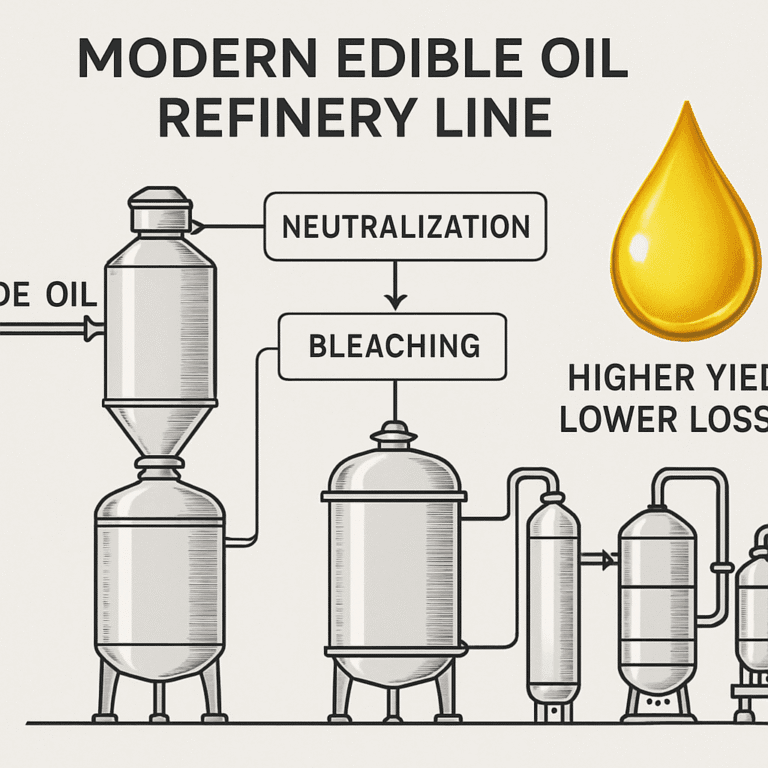

Source of Loss in Soft Oils (Canola, Soybean, Sunflower) Refining:
How to Reduce Refining Losses, Degumming, and Neutralization:
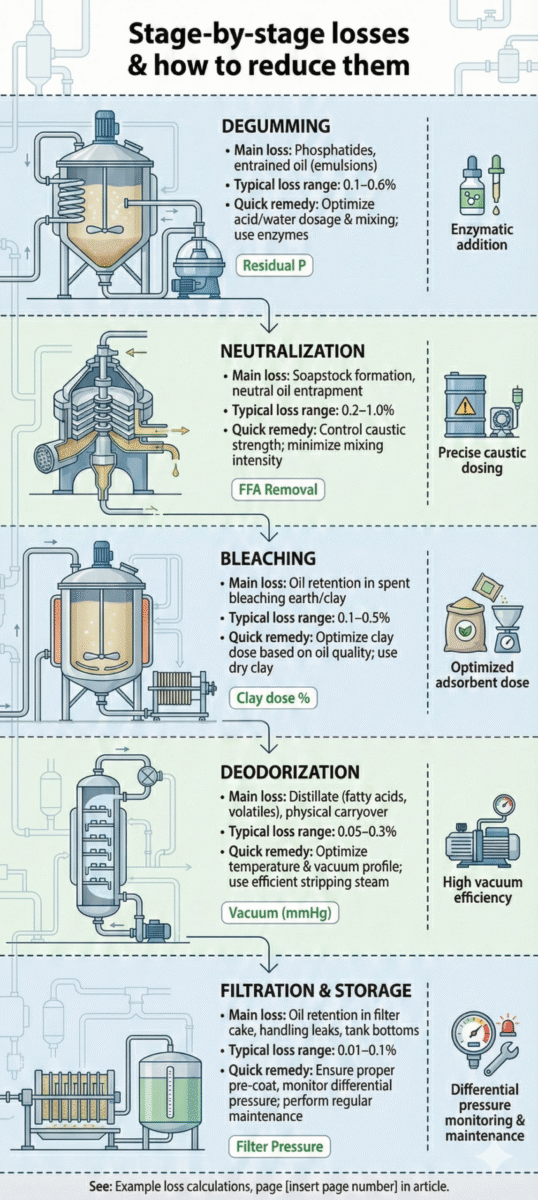
How to Reduce Refining Losses by controlling gums and soap at each stage. Phospholipids in crude oil (0.5–3%) can hold some oil.
Thank you for reading this post, don't forget to subscribe!However, proper degumming (water/acid or enzymes) removes these; for example, phospholipase enzymes convert gums into triglycerides that remain in the oil.
Soapstock from neutralization (~6% of crude volume) traps fatty acids and a bit of neutral oil, so careful caustic dosing and quick separation typically keep oil loss to ~1% or less.
How to Reduce Refining Losses in Bleaching and Adsorbent:
| Activated clays and oil loss | Activated clays remove color but also adsorb oil. |
| Oil content in spent bleaching earth | Spent bleaching earth often contains approximately 20-30% oil by weight. |
| Effect of 1% clay dose on oil loss | A 1% clay dose could trap around 0.3% of the oil. |
| Optimize clay dosage | Use only as much clay as needed; automated color/turbidity meters can stop dosing when the oil meets the color/turbidity specifications. |
| Wet bleaching with citric acid | Wet bleaching (adding water with a bit of citric acid) helps carry gums and pigments to the clay, allowing lower clay usage. |
| Oil recovery after bleaching | After bleaching, high-pressure filters or presses should squeeze as much oil as possible from the spent earth to minimize oil losses. |
How to Reduce Refining Losses: Deodorization and Distillation:
Steam deodorization removes about 0.3–0.5% of oil as volatile fatty acids. Minimizing loss requires using the lowest feasible temperature and the highest vacuum.
For example, operating at ~6 mmHg (8 bar) instead of 12 mmHg halves steam usage and reduces oil consumption.
Modern deodorizer trains employ multistage ejectors, mechanical pumps, and efficient condensers to recover nearly all volatiles.
Handling, Storage, and Operational Losses:
Losses in piping, tanks, and filters (~0.1-0.3%) can be reduced by regularly purging strainers, flushing lines, and using features such as sloped drains and closed transfer systems.
These steps ensure nearly all oil is collected, driving incidental losses toward zero.
Variation by Oil Type (Canola vs Soybean vs Sunflower):
- Different oils have different impurity profiles.
- Canola (rapeseed) often has higher gum/phosphorus content and may need citric/phosphoric acid degumming.
- Soybean and sunflower oils usually have lower gum (often <1%), so water degumming is generally sufficient.
- Sunflower oil contains more natural pigments (carotenoids) than soybean oil, so it typically requires heavier bleaching.
- Crude free fatty acid levels vary between oils; soybean and canola often enter at approximately 1-3% FFA.
- Alkali addition rates are adjusted for each oil based on its FFA level.
- Recognizing these differences allows refiners to optimize each refining step and minimize refining losses.
Process Optimization Techniques to Minimize Oil Losses: How to Reduce Refining Losses.
Optimizing Degumming (Water, Acid, Enzymatic):
Ensure complete gum removal with the minimum required water (typically about 2%), and proper mixing and temperature, so phospholipids hydrate fully.
Enzymatic degumming is especially effective; phospholipase enzymes remove over 95% of gums without alkali loss.
Monitor residual phosphorus or turbidity and stop immediately after gum removal to prevent unnecessary dilution and oil drag.
Efficient Neutralization and Soapstock Recovery:
The term ‘Does lie precisely’ is unclear. For example, automated pH or FFA probes can meter caustic exactly to neutralize FFA and shut off immediately.
After mixing, centrifuge the neutral oil quickly to avoid emulsions. Then acidulate the soapstock (typically 1-2% H2SO4, pH~1-2, under steam) to break the soap emulsion.
This converts soaps to free fatty acids and usually recovers >80% of the oil from the soap stock.
Optimizing Bleaching (Clay Type, Dose, Regeneration):
Match the type and dose of clay to oil quality. Milder clays bind less oil, so select based on required color removal, often measured online.
Using two-stage (counter-current) bleaching further improves efficiency. After bleaching, ensure filters (leaf or belt) are thoroughly dewatered to recover trapped oil.
Deodorization: Lower Temperature & Improved Vacuum:
- Operate the deodorizer under the gentlest effective conditions. For Example:
- Lower the vacuum from 12 to 6 mmHg to roughly halve steam and entrainment.
- Use efficient ejectors and mechanical pumps to maintain a deep vacuum.
- Install heat recovery (preheat feed with hot effluent) to reduce steam injection.
Byproduct Recovery and Waste Valorization:
Treat byproducts as coproducts to eliminate oil stream waste.
For example, acidulate soapstock to produce FFA-rich acid oil for biodiesel or oleochemicals. Extract 20-30% oil from spent bleaching clay using solvents or thermal methods, then recycle the oil.
Deodorizer distillate (containing FFAs, sterols, tocopherols) can be sold or reused. Filter cakes can also be processed to recover oil.
Energy and Steam Efficiency (Heat Integration):
Integrate heat to stabilize the process. For example, use a thermosyphon loop to recycle about 45-75% of the heat from the deodorizer cooling into the incoming oil.
Employ economizers and plate heat exchangers to preheat cool streams (for instance, preheat crude with hot spent oil). Return condensate to the boiler.
These measures reduce the demand for fresh steam and prevent large temperature swings.
As a result, smoother temperature control and lower steam rates indirectly reduce oil carryover and losses.
Calculating and Monitoring How to Reduce Refining Losses:
Oil Yield and Loss Percentage Formulas: How to Reduce Refining Losses:
| Yield tracking | Track yields by mass balance. |
| Yield formula | Yield (%) = 100 x (refined oil ÷ crude) |
| Loss formula | Loss (%) = 100 – Yield |
| Example | 9,900 kg output from 10,000 kg input = 99.0% yield, 1.0% loss. |
| Stage-wise use | Do this calculation for each stage (e.g., after degumming, after bleaching). |
| Side streams | Include all side streams (soapstock, spent clay, distillate). |
Tracking Key Performance Indicators (KPIs): How to reduce refining losses:
Monitor KPIs such as net oil yield, oil loss per ton of crude, and chemical usage per impurity removed.
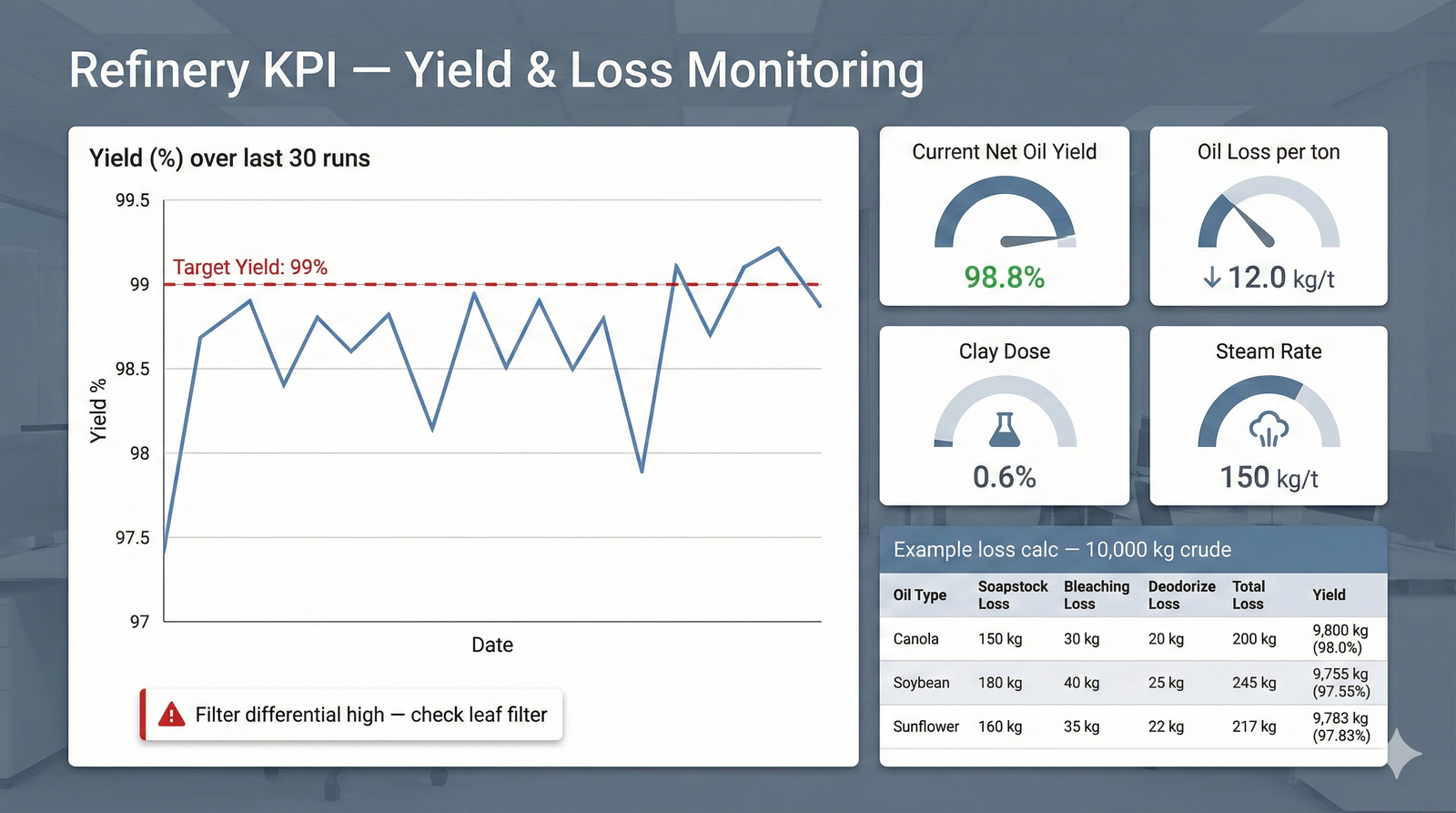
Trends in these metrics enable early identification of increases in loss, allowing prompt action before minor drifts escalate.
Data Collection: Flow Meters and Analytics
| Metering oil streams | Meter every oil stream (Coriolis, ultrasonic, etc.) and log flow, temperature, pressure, FFA, and other key data. |
| Data historian | Store process data in a historian system (e.g., OSIsoft PI, Siemens PCS7, etc.) for continuous tracking and analysis. |
| Data analysis tools | Use data analysis tools such as Excel, Python, R, or SPC software to analyze trends and identify anomalies. |
| Example: detecting filter issues | A real-time chart of bleached-oil flow versus feed would immediately highlight if a filter is partially plugged. |
| Turning data into insights | Automated reports and alarms convert raw data into actionable insights on process losses and performance deviations. |
Example Loss Calculations for Canola, Soybean, and Sunflower:
For illustration (10,000 kg crude each):
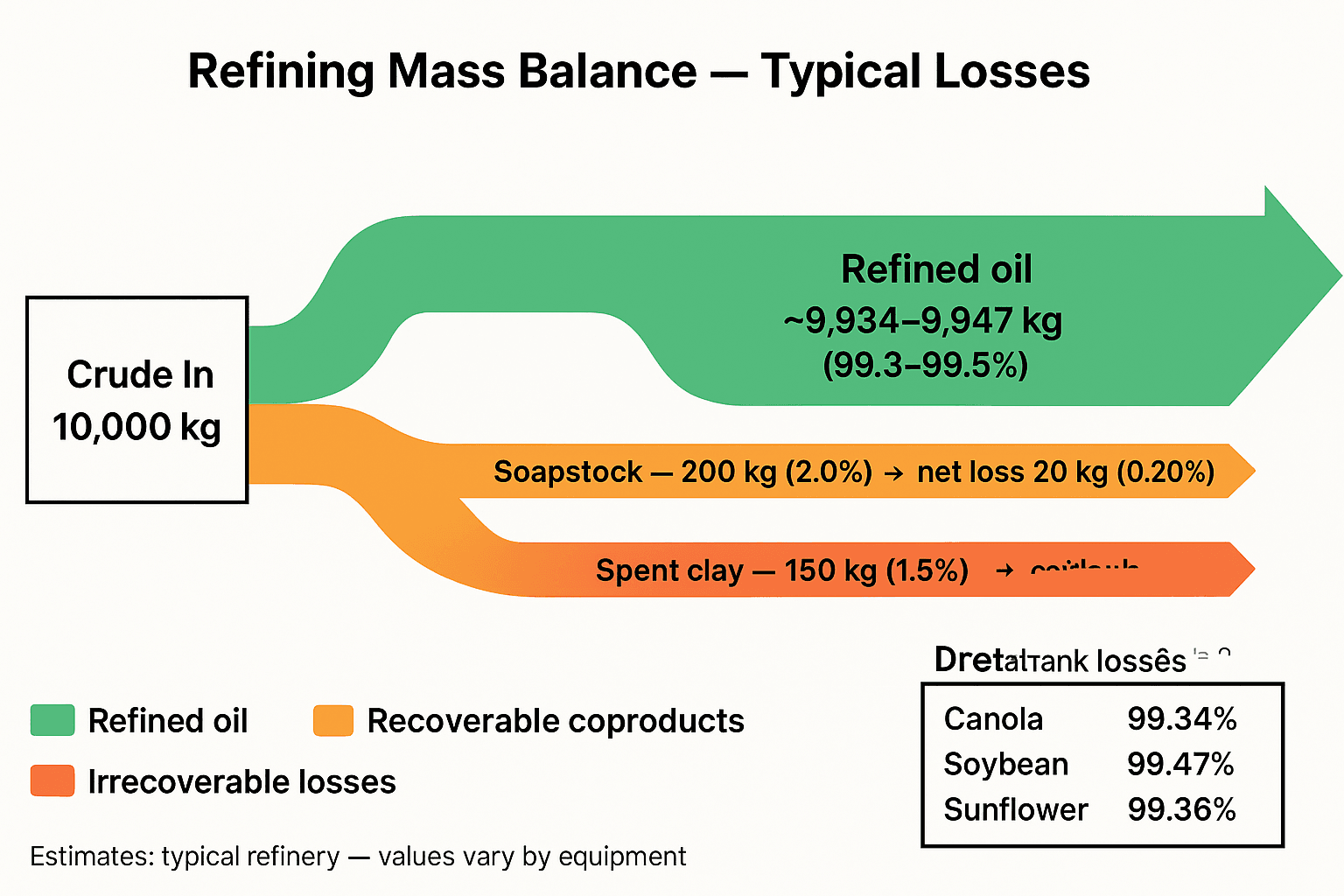
- Canola (2.0% FFA): Soapstock ≈ 200kg (acid oil ≈ 180kg, net loss 20kg = 0.20%). Bleaching 1% clay retains ≈ 30kg of oil (if 80% recovered, loss ≈ 6kg = 0.06%). Deodorize Stripping ≈ 40kg (0.40%). Total ≈ 66kg lost (0.66% overall loss).
- Soybean (1.5% FFA): Soapstock ≈ 150kg (loss ≈ 15kg = 0.15%). Bleaching 0.5% clay retains ≈ 15kg (80% recovered, loss ≈ 3kg = 0.03%). Deodorize ≈ 35kg (0.35%). Total ≈ 53kg (0.53% loss).
- Sunflower (1.0% FFA): Soapstock ≈ 100kg (loss ≈ 10kg = 0.10%). Bleaching 2% clay retains ≈ 60kg (85% recovered, loss ≈ 9kg = 0.09%). Deodorize ≈ 45kg (0.45%). Total ≈ 64kg (0.64% loss).
In each case, the yield is ≈ 99+%. (Actual values depend on equipment and recovery efficiency, but these estimates show that refining losses are typically well under 1% per batch.)
Software and Tools for Data Analysis:
Plant software, such as MES/SCADA dashboards and data historians, turns collected process data into actionable insights by alerting engineers to excess losses.
This early warning capability enables rapid intervention to minimize refining waste.
Equipment and Technology to Support How to Reduce Refining Losses:
Vacuum and Condenser Systems for Deodorization:
Use multistage vacuum systems to reach deep vacuum (≤5 mbar). Oversize the condenser (e.g., multi-pass shell/plate units) so that >95% of volatile oil condenses out.
A leak-tight, well-maintained vacuum system keeps steam usage low and oil in the loop.
High-quality pumps (Alfa Laval, Leybold, etc.) and pressure sensors ensure the vacuum stays at setpoint, minimizing oil carryover.
Advanced Bleaching and Filtration Equipment:
Employ robust bleachers and filters. For example, counter-current bleaching units squeeze every bit of oil from spent earth.
Use efficient mixers and a metered feed to disperse the clay thoroughly. High-capacity pressure or belt filters with cake wash recover oil efficiently.
Features such as cake shakers or pneumatic discharge minimize residual oil in the clay. Automated filter cleaning or bypass alarms prevent oil loss from blinding.
Automation and Control Systems for Precision:
- Modern PLC/SCADA systems (Siemens SIMATIC, Rockwell PlantPAx, ABB 800xA, etc.) lock in optimal operating conditions.
- Automated valves and feedback loops (e.g., closed-loop pH, turbidity, or color control) ensure chemicals are dosed precisely.
- A controller can meter alkali until an online FFA sensor reads near zero, then shut off dosing instantly.
- Alarms and interlocks (for pump failures, over-temperature, vacuum loss, etc.) detect and flag problems immediately.
- Recipe control allows the system to switch between different oils without manual reset or extensive adjustment.
- In short, automation reduces human error, prevents overshoot, and helps maintain peak yield.
Membrane and Enzymatic Purification Technologies:
- Next-generation technologies can significantly reduce traditional refining losses.
- Nanofiltration membrane units (e.g., Sepure’s systems) can remove FFAs directly without caustic, bypassing soapstock formation entirely.
- Ultrafiltration membranes and adsorber systems can strip out trace gums or oxidation products without relying on bleaching clay.
- Enzymatic processes now extend beyond simple degumming; specialized lipase modules can convert FFAs to esters in-line.
- Modular systems from technology providers such as Sequana/Novozymes and Alfa Laval enable refiners to deacidify or polish oils with minimal oil being “caught” or lost in the process.
Quality Control and Best Practices in How to Reduce Refining Losses:
Free Fatty Acid (FFA) and Peroxide Testing:
Test oil frequently: Verify that each stage meets quality targets, e.g., the final refined oil should have FFA < 0.1% and peroxide values near zero.
If FFA or peroxide exceeds the control limits, adjust the process immediately (e.g., add more lye, extend bleaching time, etc.).
By staying on spec, you avoid having to re-refine or blend entire batches, which would waste yield.
Real Time Monitoring (Sensors and SCADA):
Online sensors and SCADA dashboards catch deviations instantly.
For instance, a turbidity meter after bleaching can detect clay breakthrough, triggering an alarm to change the filter before oil is lost.
Moisture or quality sensors in filters or adsorbers ensure performance. Automated alerts (email/text) on key variables (flow drops, level changes, unexpected pH swings) ensure staff intervene before minor issues grow.
Operator Training and Standard Operating Procedures:
Well-trained operators are key. When staff understand how each step affects yield, they follow SOPs rigorously. Use checklists (e.g., for startup/shutdown and chemical prep) so no step is skipped.
For example, an SOP might require fully draining and rinsing the degumming tank after each batch.
Regular drills and refresher training (on upsizing clay, pumping techniques, spillage response, etc.) keep everyone aware that saving oil is a priority.
A vigilant team will catch anomalies (foam, odd noises, or odors) early and prevent avoidable losses.
Preventive Maintenance and Calibration Programs:
Maintain all equipment to avoid hidden leaks. Replace worn pump seals and valve packings before they drip.
Pressure-test vacuum lines and condensers routinely. Calibrate flowmeters, scales, and analytical probes on schedule to ensure data remains accurate.
(A mis-calibrated flow meter could mask a 1% loss!) A robust preventive maintenance schedule (often using CMMS software) keeps equipment in spec, minimizing unscheduled downtimes and waste.
In practice, a few minutes of planned maintenance can prevent hundreds of kilograms of oil from leaking over the course of a year.
Compliance with Global Quality Standards (Codex, ISO):
- Follow international and customer standards to keep all batches saleable.
- Codex Alimentarius and ISO define maximum limits for FFA, insoluble, moisture, etc.
- Meeting these specifications allows oil to be shipped immediately rather than being downgraded.
- Quality systems such as ISO 9001 and FSSC 22000 enforce consistent procedures and continuous improvement, helping identify inefficiencies.
- In short, adhering to these standards ensures your process stays disciplined, resulting in steady yield and minimal rejects.