

Edible Oil Refining Troubleshooting, and order in traditional oil production:
Ancient techniques and practical remedies:
Edible oil refining troubleshooting has been a challenge for millennia, as people pressing oil from olives, sesame, mustard, and other seeds have wrestled with the same three problems modern refiners still face: color change, formation, and unpleasant aroma.
Thank you for reading this post, don't forget to subscribe!In the ancient Mediterranean and Near East, crude pressing produced cloudy, dark oils that often darkened further with heat or age.

Producers learn to settle and decant repeatedly, and to store oil in cool, dark amphorae, which results in visible darkening.
Regional practices and masking methods:
Foam appeared during heating, and clarification artisans observed that particulates and natural surfactants were responsible for the frothing. Hence, they skimmed, filled with cloth, straw, or sand, and used slow heating to reduce agitation.
Odor troubled users too: rancid or “fishy” notes resulted from early oxidation and all contamination.
To mask or remove smells, people perfumed oils with herbs such as rosemary or citrus peels, and they preferred fresh, locally pressed oil for cooking.
Across Asia and Europe, similar empirical fixes emerged, such as settling, simple filtration, aromatic additives, and careful storage.
Although lacking modern analytics, these time-tested practices anticipated today’s troubleshooting: identify the cause, apply our target remedy, and prevent recurrence.
Edible Oil Refining Troubleshooting: Introduction to Quality Failures:
When refining vegetable oils, even minor process deviations can cause big quality problems. First, you must identify symptoms quickly;
Second, you must apply proven corrective steps; Finally, you must prevent recurrence with process controls.
In short, this edible oil refining troubleshooting guide helps you spot the root causes of colour reversion, foaming, and Odor, and then fix them efficiently.
Moreover, it prioritizes practical actions you can take on the plant floor today.
Understanding the causes of colour reversion in refined oils: Edible Oil Refining Troubleshooting,
Edible oil refining troubleshooting: Where is colour reversion?
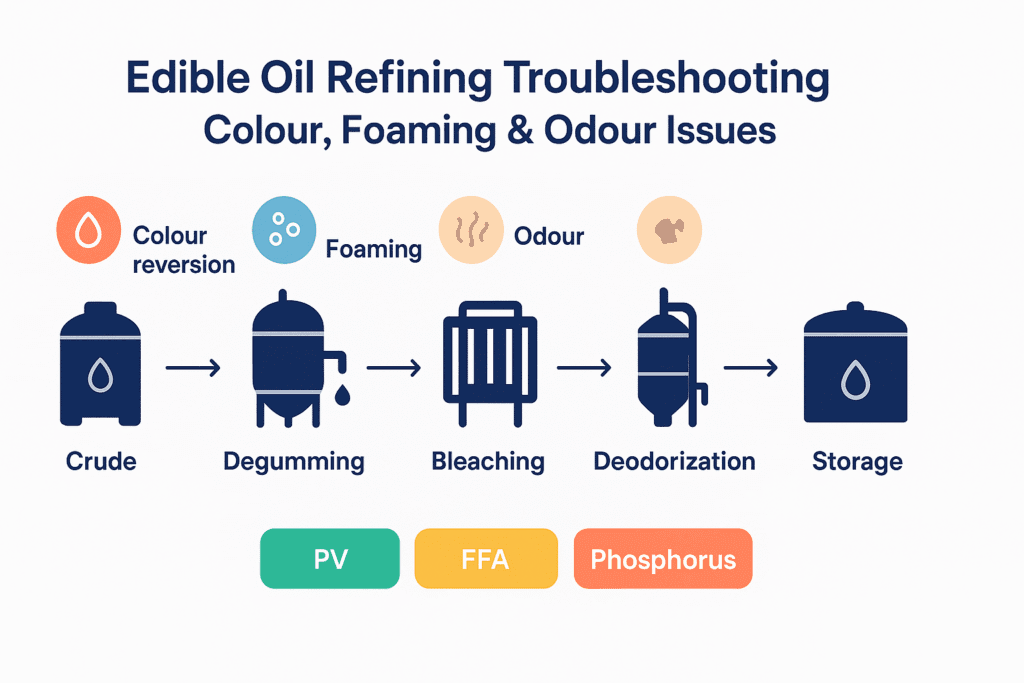
Colour reversion means a refined oil that looks pale and clear after refining, losing its darkness during storage or heating. In practice, colour reversion reduces consumer appeal and may imply accelerated oxidation. Therefore, you should treat it as both a cosmetic and a quality issue.
Factors contributing to colour instability: Edible Oil Refining Troubleshooting,
Firstly, residual pro-oxidants such as trace metals (iron, copper) catalyse oxidation. Secondly, insufficient bleaching leaves pigments and metal complexes behind.
Thirdly, hidden utilisation temperatures can create unstable compounds that later revert to their original colour. Finally, poor storage conditions, light, heat, or oxygen accelerate the process.
Troubleshooting and corrective steps:
- Remove metal ions: use appropriate adsorbents or chelating agents, and ensure effective Centrifugation during degumming.
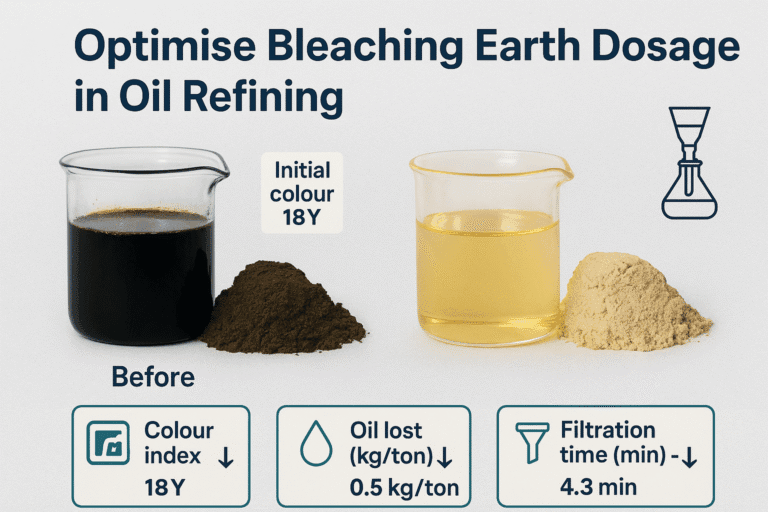
- Optimise bleaching: test different types of bleaching earths, increase contact time moderately, and control dosage precisely.
- Controlled deodorization: lower the temperature slightly while extending the steam stripping time to remove volatiles without forming thermal degradation products.
- Improve storage: use opaque, oxygen-barrier tanks; Purge headspace with nitrogen where feasible.
Consequently, you reduce the chemical drivers of reversion while maintaining yield.
Why Foaming Occurs in Refining or Deodorization:
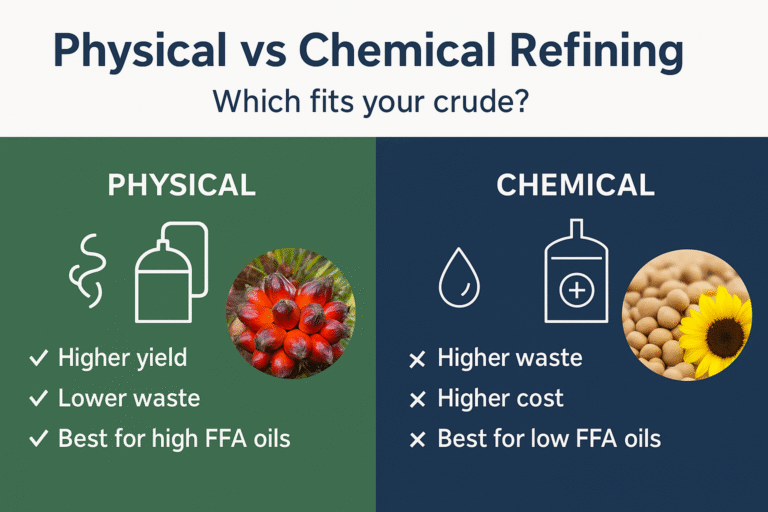
Foaming arises when surface-active compounds (phospholipids, soaps, detergents, or free fatty acids) concentrate in process streams.
Moreover, the presence of particulates and emulsifiers in crude oil or process water increased the form stability.
As a result, form leads to product loss, inefficient separation, and potential safety risks in vacuum systems.
Impact of Foaming on Product Quality:
Forming decreases separation efficiency, drags impurities into refined oil, and sometimes causes carryover to downstream units. In short, foaming harms both yield and quality.
How to Control or Eliminate Foaming:
- Source control; Filter the crude and stabilise feedstock; Monitor extraction solvent residues if applicable.
- Chemical antifoams: Use silicone- or mineral-oil-based antifoams in controlled doses; always run a small-scale trial first.
- Mechanical fixes: Slow down feed rates to separators, check Internals for wear, and maintain proper steam injection rates.
- Water management: remove access process water promptly and avoid entrained moisture entering vacuum systems.
Therefore, by combining chemical and mechanical strategies, you can manage forming without compromising oil integrity.
Odour issues in edible oils: identification and corrective actions:
Common Odour Problems in Edible Oils:
Unpleasant odours come from free fatty acids, volatile free fatty acid oxidation products, sulphur compounds, or residual solvents.
For example, a fishy odour often signals oxidation of polyunsaturated fats or contamination from marine-origin feedstocks.
Role of Deodorization Parameters:
Adjust the deodorization temperature, steam flow, and vacuum to strip off volatile odour compounds while avoiding thermal breakdown.
Meanwhile, stick to validated temperature-time profiles for your oil type, especially for highly unsaturated oils.
Troubleshooting Techniques to Reduce Odour:
- Analytical check: Run GC-MS or GC-FID to identify volatile odour compounds and quantify them.
- Use my lab elements: In some cases, post-deodorization polishing with activated carbon or specific bleaching clays can reduce remaining odors.
Increase steam stripping: improve stripping efficiency by optimising nozzle design and steam purity.
Lower processing temperature: When possible, choose milder deodorisation conditions and extend residence time to prevent the formation of new volatiles.
Thus, targeted analytical work combined with process tweaks resolves order issues more quickly and safely.
Comparative QC colouring | foaming Odour:
| QC parameter | Colour reversion (sign & action) | Foaming (sign & action) | Odour (sign & action) |
| Peroxide value (meq O²/kg) | Indicates oxidation. Add antioxidants, lower storage temp | Or slightly check phospholipids first | Signals volatiles boost steam stripping, adjust deodorization |
| Free fatty acid (FFA%) | Can darkening on heat improve neutralization | Creates soaps to optimise caustic dosing & washing | Produces stale/ fishy notes, reduces FFA + tunes deodorization |
| Phosphorus/ Phospholipids (ppm) | Carries pigments/metal improves degumming/bleaching | Primary foam driver degums better use antifoam | Traps volatiles enhance degumming & polishing |
Research & innovation: Edible Oil Refining troubleshooting studies,
Key Findings from Recent Studies:
Recent trials show that adding antioxidants like ascorbyl palmitate and mixed tocopherols before refining delays oxidation and reduces colour reversion.
Likewise, common trials demonstrate that low-temperature deodorisation with optimised vacuum reduces the formation of glycidyl esters and off-odour precursors.
Overall, the evidence favours milder thermal regimes combined with better pre-treatment.
Novel Antioxidants and Process Innovations:
For instance, ascorbyl palmitate and tocopherols blend act synergistically: they protect pigments and delay peroxide formation.
Additionally, enzymatic degumming improves phospholipid removal, reducing soap formation and the risk of forming.
Consequently, these methods yield clearer oil and more stable storage profiles.
Advanced Analytical and Monitoring Techniques
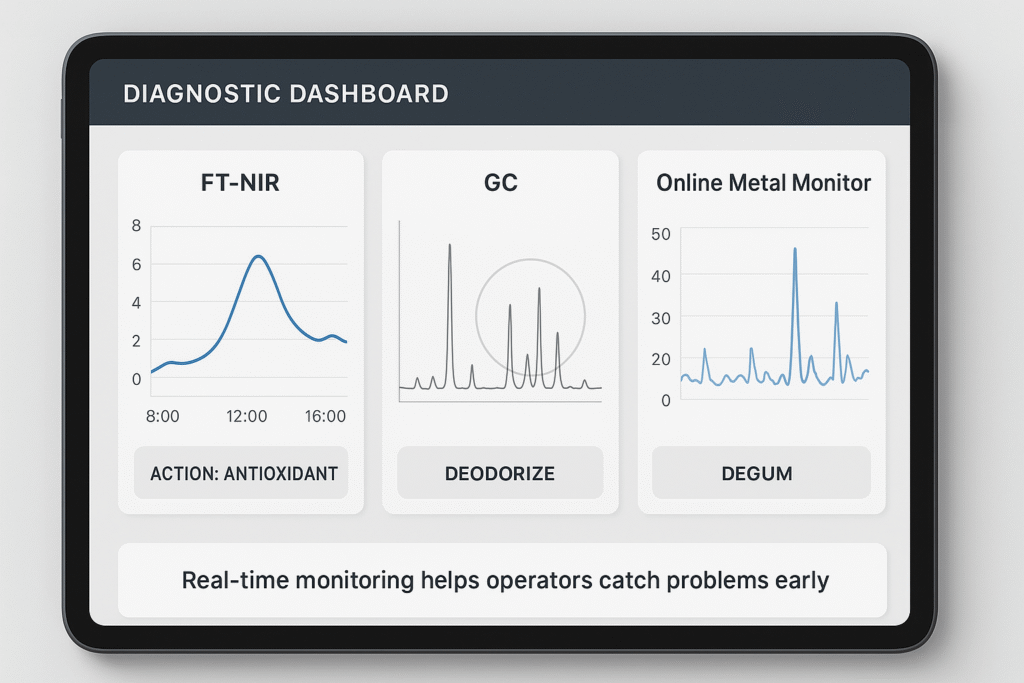
- Use FT-NIR for real-time monitoring of peroxide value & moisture trends.
- Run GC (GC-MS / GC-FID) routinely for volatile compound profiling and odour source identification.
- Install online metal monitors to detect trace amounts of Iron or copper early.
- Correlate online sensor data with lab tests to create action thresholds (example: PV, metals) for operators.
- Set up alerts and standard operating responses so staff can intervene immediately when readings exceed limits.
Industry Case Studies and Pilot Trials:
- Pilot trials show reduced colour reversion when mills combine improved degumming, optimised bleaching, and antioxidant dosing.
- Case studies report fewer odour complaints after switching to mild utilisation with extended steam stripping.
- Implement combined process changes (pre-treatment, bleaching, antioxidants, and deodorisation) in small pilots before full rollout.
- Use pilot data to define cost/benefit, validate SOPs, and train operators before plant-wide adoption.
- Document pilot outcomes and create a short checklist for scaling successful measures.
Preventive measures for consistent refining quality:
Defining Parameter Optimisation:
Always maintain targeted temperatures, residence times, and steam rates.
First, document standard operating procedures for each oil type. Second, train operators should follow the checklist and log deviations immediately.
Third, run small-batch validations when changing feedstock. These steps reduce variability and support reproducible outcomes.
Use of Antioxidants and Stabilisers:
Apply antioxidants at validated dosages and lose points.
For example, dozing before bleaching often gives better pigment protection, while post-deodorisation antioxidants aid storage life.
Also, rotate antioxidant types in trials to determine the best combinations for particular feedstock.
Storage and Handling Best Practices:
Store refined oils under an inert atmosphere where feasible, maintain cool temperatures, and avoid light exposure.
Likewise, practice FIFO inventory control and monitor tank integrity. As a result, you decrease the chance of post-refining deterioration that leads to reversion, forming, or odour.
Operational Controls and Training
Implement routine sensor checks for vacuum level, steam quality, and metal traces.
In addition, maintain a QC sampling schedule with clear acceptance limits. Finally, encourage quick corrective reporting and root-cause meetings after any deviation.
Edible Oil Refining Troubleshooting: Key Takeaways and Final Thoughts:
Apply this Edible Oil Refining Troubleshooting approach: identify, correct, and prevent.
First, promptly identify the symptom colour, form, or odour, then run targeted diagnostics such as FT-NIR and GC.
Second, correct with process adjustments: improve degumming, optimise bleaching dosages, use measured antifoams, & adjust deodorization steam and vacuum.
Third, prevent recurrence through antioxidants, better storage, and operator training.
Importantly, integrate modern monitoring tools and follow research-based practices.
Moreover, run pilot trials before scaling innovations. Consequently, you will maintain product quality, protect brand reputation, and improve plant yield.
In conclusion, practical troubleshooting that pairs good diagnostics with measured process changes keeps your refining operation resilient.
Use this guide as the checklist; next, draft specific SOPs for each unit process and train your team.
Then monitor results and refine your control to ensure your refinery delivers consistent, high-quality edible oils.