

Gas Chromatograph guide Friendly overview and what to expect:
The gas chromatograph guide explains the GC-2010 in plain language, so your lab team can set up, run, and maintain the instrument with confidence. First, you’ll learn what the instruments do and why they matter.
Thank you for reading this post, don't forget to subscribe!Then, step by step, you’ll see how to install the unit, handle columns, choose detectors, write methods, and solve common problems.
Finally, you’ll get a concise checklist to use before every run. This approach saves time, reduces mistakes, and helps new operators become productive quickly.
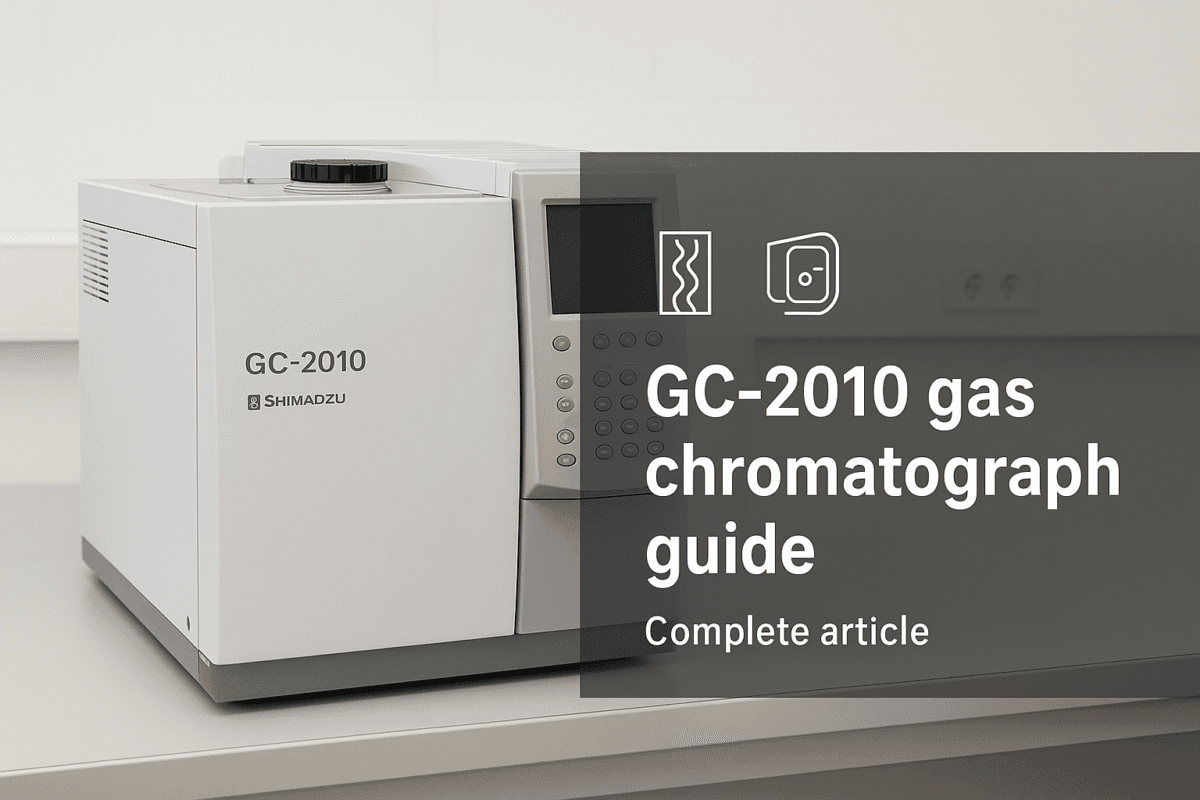
What makes the GC-2010 useful:
- The GC-2010 delivers stable chromatography and supports rapid temperature programming, resulting in faster runs and improved peak separation for complex samples.
- In practice, that improves throughput and reproducibility.
- Moreover, the instruments support several detector types, offer programmable gas flows, and provide diagnostic logs that help spot issues early.
- Consequently, labs get more reliable data and less downtime.
GC-2010 gas chromatograph guide: Installation, and safety first:
The GC-2010 gas chromatograph guide begins with basic site planning and safety steps because correct installation prevents many later problems.
First, pick a stable, ventilated bench away from corrosive fumes and strong electromagnetic sources.
Next, check that your power, gas, and exhaust supplies meet the instrument’s requirements.
Finally, follow the manual’s emergency shutdown procedures so everyone knows what to do in an emergency.
Site, power, and gas basics:
Always confirm the unit’s voltage (100V vs 230V models) and use dedicated outlets.
Then, secure the carrier, detector, and makeup gas lines with proper fittings. If you use hydrogen, place gas cylinders so they are stable and not exposed to heat. Also, label high-temperature surfaces and ensure good room ventilation, as detector flames and heated zones pose hazards if not handled properly.
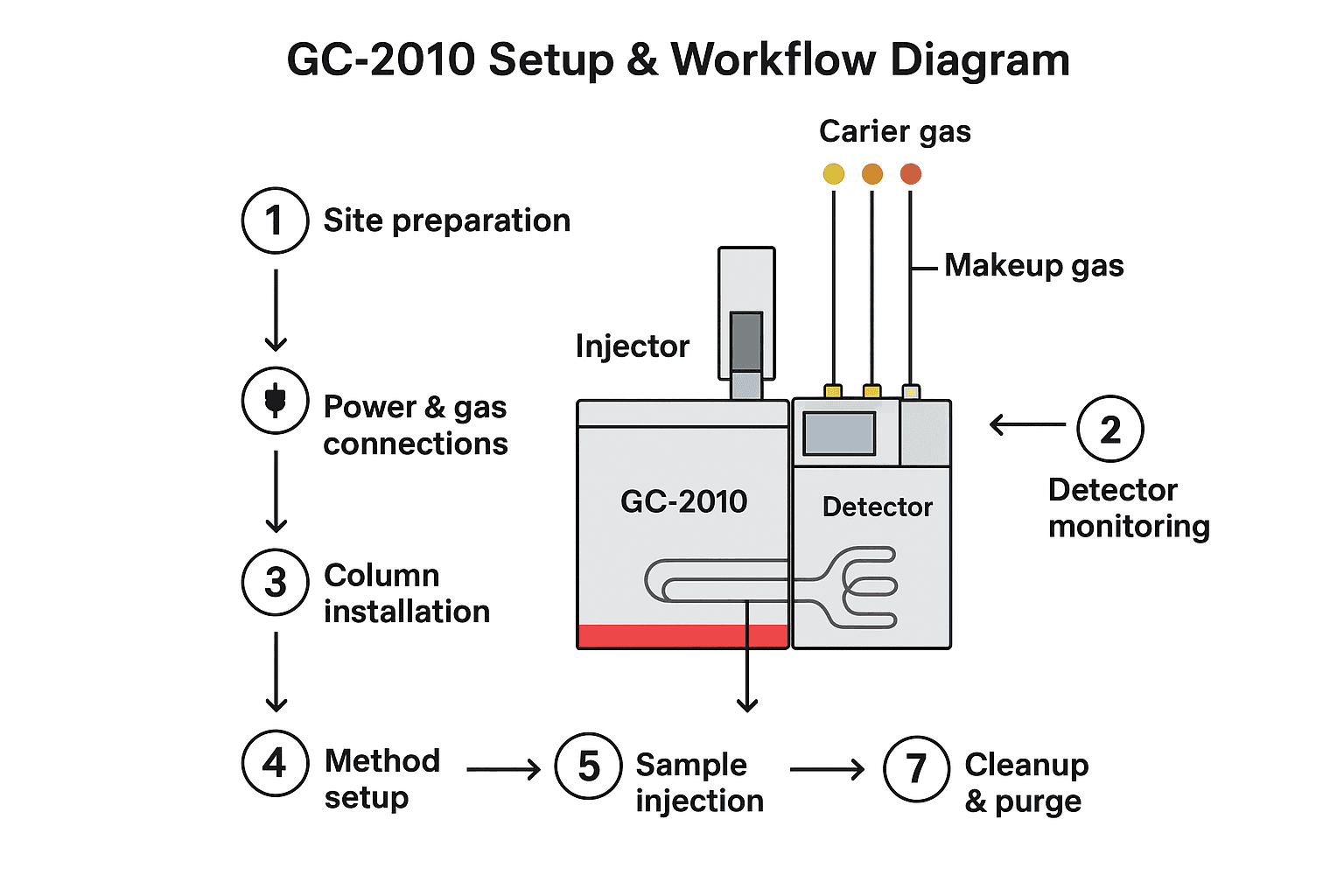
Practical tip: first-hour setup:
When you unpack the GC-2010, inventory all parts, then power the unit on only after verifying gas connections.
Use a leak-check solution at fittings and listen for hisses. If you find a leak, shut the cylinder valves and fix the fittings before proceeding.
Gas chromatograph guide: Column selection and careful installation:
The GC-2010 gas chromatograph guide emphasizes that proper column handling has the most tremendous impact on chromatography quality.
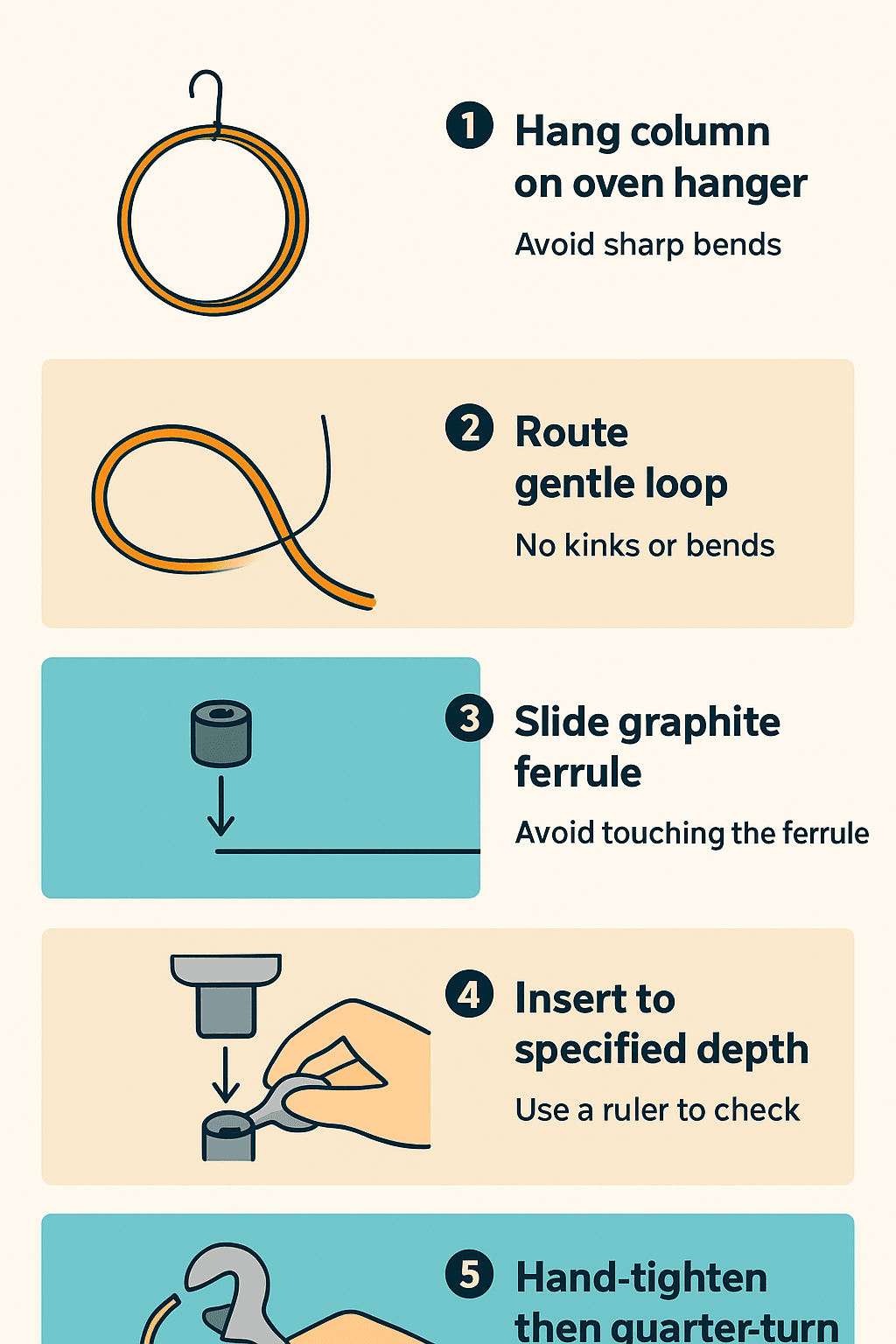
Therefore, learn to install columns carefully, trim them squarely, and route them with gentle loops inside the oven.
These small steps reduce dead volume, leaks, and peak tailing.
Capillary column installation:
Start by hanging the column on the provided oven hanger, making sure it doesn’t touch the oven walls. Then, slide graphite ferrules onto each end, insert the column tip to the specified depth, and hand-tighten the nuts before making a final slight turn with a wrench. After that, trim the tip squarely. If the cut is uneven, you risk leaks and poor peak shape. Always allow heated parts to cool before handling to avoid burns.
Heated zones and placement:
Place injection ports and detectors into the recommended zones.
For example, placing the injection port in certain zones may prevent auto-injector installation, so decide placement during planning.
Furthermore, the positioning affects heat transfer and, consequently, retention times; therefore, document the chosen layout in your method for reproducibility.
GC-2010 gas chromatograph guide: Injection techniques and detector basics:
| Topic | Description |
| Injection Choices | The GC-2010 gas chromatograph guide clearly explains injection methods and detector setup so that you can match the technique to the sample. |
| Split Injection | Because it consumes hydrogen and uses an open flame, you must follow strict safety steps. |
| Splitless/ On-column Injection | Splitless or on-column injections suit trace-level work. |
| Detector Option | Detector choices (FID, TCD, FPD, etc.) depend on the chemical classes you measure. |
| FID Fundamentals | The FID measures ions produced when organic molecules burn in a hydrogen flame; as a result, it responds well to hydrocarbons. |
| Safety requirements | Because it consumes hydrogen and uses an open flame, you must follow strict safety steps. |
| Pre-Ignition Checks | Always check hydrogen and air flows before ignition, confirm the flame stabilizes, and shut gas valves when the system is idle |
| Jet Maintenance | Maintain flame jets clean to avoid ignition failures. |
Detector setup and practical checks:
Configure makeup gas, hydrogen, and air flows according to your detector’s recommended values.
After igniting the detector, allow it to stabilize for a short time and check the baseline.
If the baseline is noisy or drifting, adjust the filter time constant or check flow stability. Also, turn off unused detectors to conserve gas and reduce false alarms.
GC-2010 gas chromatograph guide Writing methods: temperature and flow programs:
The GC-2010 gas chromatograph guide shows how to build robust temperature and flow programs that yield reproducible retention times.
First, choose isothermal runs for simple mixtures; otherwise, ramp the oven to handle broad boiling ranges.
Then, validate each program by repeating injections and adjusting ramps to sharpen peaks without sacrificing resolution.
Flow control options:
You can choose pressure control or constant flow.
Pressure programming helps when you want specific head pressure, while constant flow preserves linear velocity.
Therefore, test both modes during method development and document your chosen approach.
File management and method discipline:
Save each validation method under an explicit filename and include versioning notes.
Before each run, load the correct method to avoid operator errors.
Additionally, back up method files regularly so you can restore them after firmware updates or accidental deletions.
GC-2010 gas chromatograph guide: Running analyses and monitoring:
The GC-2010 gas chromatograph guide walks through the run cycle: prepare, set, run, and verify.
First, prepare samples and cleanware; next, confirm gases and methods; then run and monitor; finally, review results and log them.
This routine reduces rework and ensures consistency.
During the run, what to monitor:
Watch oven temperature, detector baselines, and gas flows on the monitor screens.
If peaks shift or split, shapes change, pauses,e or check column connections or gas stability.
Meanwhile, use the instrument’s DIAG and log screens to capture warnings and errors for later troubleshooting.
Practical tip: cleanup and purge:
Use the Clean UP routine when switching sample types or before storage to purge residual sample and prevent contamination.
Also, when you finish a batch, follow the stop sequence to perform a controlled gas shutdown and avoid flameouts or detector damage.
Gas chromatograph guide: Critical addendum:
Expanded actionable content:
- First, add routine calibration steps to keep results traceable and defensible.
- For example, perform a weekly retention-time check using a calibration standard and the log deviation.
- Next, validate any new method using system suitability tests: check theoretical plates, resolution, and tailing factor before publishing results.
- Also, maintain a spare-parts list for injectors, ferules, septa, jets, and igniters to avoid extended downtime.
- Moreover, schedule monthly preventive maintenance that includes jet cleaning, septa replacement, and column inspections; as a result, you’ll catch minor problems before they grow.
- Finally, train operatorsshould useh a short competency checklist and sign-off sheets so everyone follows the same SOPs.
GC-2010 gas chromatograph guide: Troubleshooting and long-term care:
The GC-2010 gas chromatograph guide provides practical diagnostics that save hours of time.
For instance, many ignition or baseline problems have simple causes: low gas pressure, clogged jets, or loose fittings.
Therefore, create a short troubleshooting flow that operators can follow before escalating to service calls.
Common issues and fixes:
If FID won’t ignite, verify the gas supply and the jet’s cleanliness.
Is the baseline noisy? Increase the filter time constant or check for flow instability.
If the peak tails, re-cut the column tip and reseal the ferrule.
Additionally, keep spare jets and ferrules on hand so you can quickly swap a suspect part.
Using logs and diagnostics:
When issues recur, review the operation logs and diagnostic reports.
These records reveal patterns such as increasing purge durations or repeated error codes that point to aging components.
As a result, plan preventive maintenance before failure causes significant downtime.
Gas chromatograph guide: Daily and monthly checklists:
The GC-2010 gas chromatography guide ends with clear lists you can print and tape to the instruments.
Use the daily checklist before starting work and the monthly checklist for routine care. Doing so boosts reliability and extends the life of your GC.
Quick pre-run checklist:
Confirm correct power and gas connections.
Check for gas leaks and tighten fittings if needed.
Verify column placement and ferrule cuts.
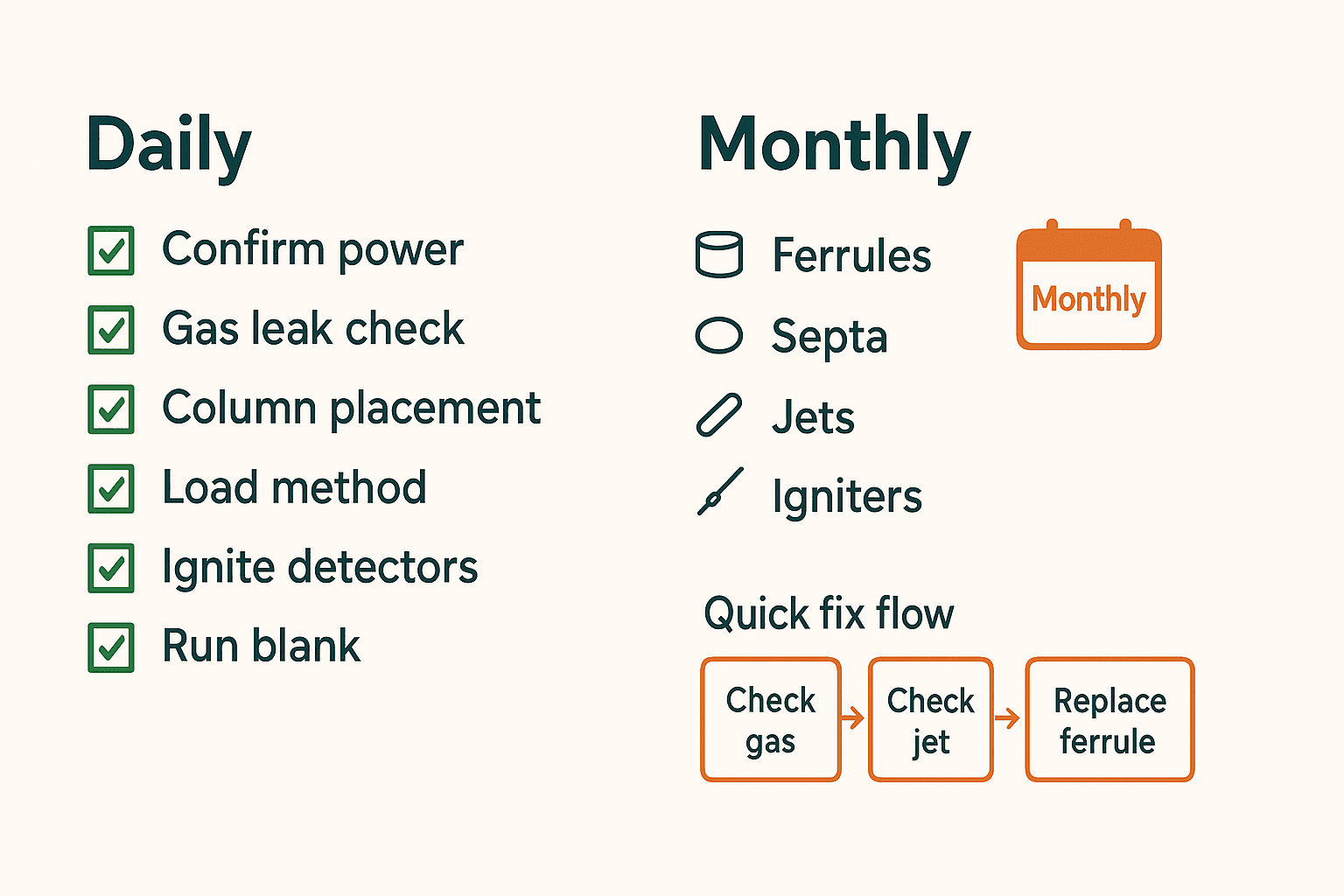
Load the correct method file and review parameters.
Ignite detectors and confirm stable baselines.
Run a system blank if you switched sample types.
Monthly maintenance checklist:
- Inspect and replace worn ferrules and septa.
- Clean jets and check the igniter conditions.
- Run diagnostics logs and archive them.
- Verify the oven temperature calibration and make any necessary adjustments.
GC-2010 gas chromatograph guide: Final thoughts and where to read more:
The GC-2010 gas chromatograph guide provides a user-friendly roadmap from installation to advanced troubleshooting.
By following a consistent setup, documenting methods, and using the unit’s diagnostics, you’ll enjoy better data and fewer interruptions.
For full technical specifications, step-by-step procedures, and safety warnings, always consult the original Shimadzu GC-2010 manual.